
Newsom, state partners launch California Men’s Service Challenge, call for 10,000 male mentors
Get AI-powered insights, summaries, and transcripts
Subscribe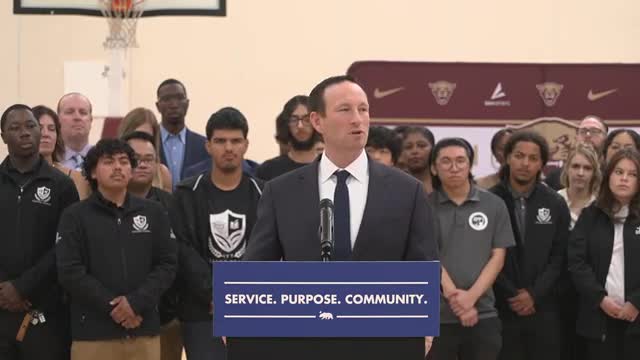
Summary
Governor Gavin Newsom joined state and nonprofit partners at Florin High School to announce the California Men’s Service Challenge, a statewide call for 10,000 young men to serve as mentors, tutors and volunteers, and to promote paid service pathways through the California Service Corps and College Corps.
SACRAMENTO — Governor Gavin Newsom and state service leaders on Tuesday launched the California Men’s Service Challenge, calling on 10,000 young men across the state to sign up as mentors, tutors, coaches and disaster-relief volunteers and offering paid service pathways through existing state programs.
The announcement, delivered at Florin High School in Elk Grove with school and nonprofit partners on hand, is part of an executive order and statewide strategy the governor said aims to address rising suicide and disengagement among boys and young men. “We have a crisis in this country of men and boys,” Governor Gavin Newsom said. “We are organizing a strategy to address it.”
The initiative is intended to expand both volunteer and paid opportunities. “Today, California is launching the California Men’s Service Challenge calling on 10,000 young men throughout our state to step up and serve their community to be mentors and tutors and sports coaches and leaders every single day,” said Josh Friday, chief service officer for the state of California and director of the Governor’s Office of Service and Community Engagement. Friday directed people to the initiative’s sign-up portal and partner network at menservicechallenge dot com.
Why it matters: Speakers framed the effort as a response to mental-health, education and civic-engagement gaps for boys and young men. Leaders said mentorship benefits both the mentee and the mentor and can reduce isolation that contributes to higher suicide rates. “Service is the key impactful component of how we’re able to move young men from being average, right, to being good, but to being great,” Michael Lynch, cofounder and CEO of Improve Your Tomorrow, said during remarks.
Support and incentives: State leaders said the challenge will tap existing programs and partners, including Improve Your Tomorrow, Mentor California, Big Brothers Big Sisters, the YMCA, the Giants Community Fund and Junior Giants, and will provide paid options through the California Service Corps and College Corps. Newsom described one college-service pathway’s terms during the event: “450 hours of work, $10,000 we provide in return, for their college education.” Josh Friday said the initiative bundles real economic and career incentives with volunteer roles to attract participants.
Voices with lived experience: Students and program alumni spoke about the initiative’s effects. Adam Allen, who graduated from Valley High School, described how mentoring changed his path: “it was not only inspiring but it motivated me to do better,” he said, and later returned to the program as a mentor and program director.
Implementation: Newsom and other speakers said state staff and nonprofit partners will recruit mentors, develop placements and support schools and community groups. Brooks Allen was identified at the event as leading state efforts to implement the executive order’s principles and details. Organizers asked local partners to expand regular-school, after-school and summer opportunities and to recruit men to serve in schools and community programs.
Numbers and context provided at the event: leaders cited high rates of suicide among young men compared with young women and repeated several statistics about mentoring shortages — including references to “one in three” young people lacking a caring adult and to men being multiple times more likely than women to die by suicide. Speakers acknowledged differing figures during the program: Josh Friday said young men are “3 times as likely to die by suicide,” and Governor Newsom later described the ratio as “4 times more likely.” The organizers did not provide a specific, single-source citation for those figures at the event.
What’s next: The governor and partner organizations urged interested people and organizations to sign up as mentors or partner hosts and for additional partners to register with the initiative. Organizers said outreach will continue through schools, sports programs and community groups to meet the 10,000-mentor goal.