
Council approves downtown business parking permit pilot on College Street
Get AI-powered insights, summaries, and transcripts
Sign Up Free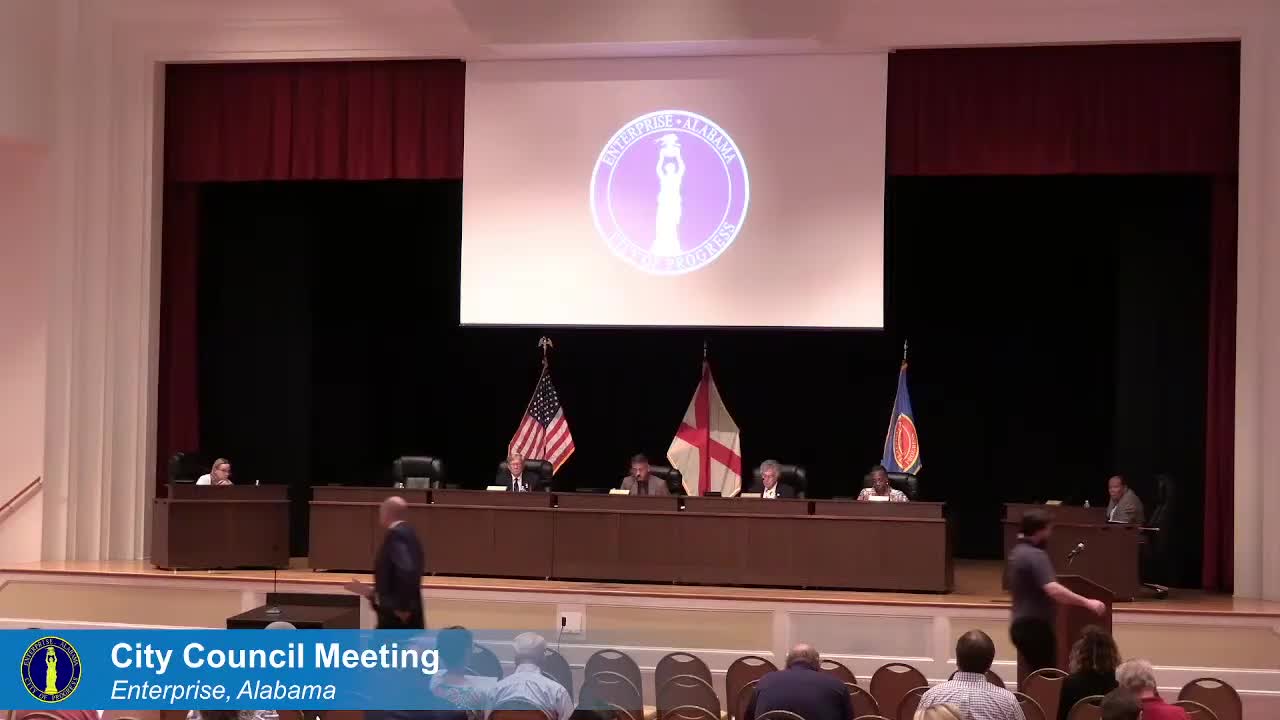
Summary
Enterprise approved an ordinance allowing property owners on East College Street to apply for a limited designated business parking permit — one parking space per property — intended to address parking needs for small downtown businesses during business hours.
The Enterprise City Council on Sept. 16 approved an ordinance to create a designated business parking permit program along a limited stretch of East College Street to help small downtown businesses that lack private parking.
The program covers a segment described by staff as the corridor roughly from the monument to the courthouse. Permits must be requested by property owners — not by business tenants — and staff said eligibility will require a current business license, up‑to‑date tax remittance where applicable, and buildings that pass inspections to meet current code. Staff said the program is expected to involve roughly 10 property owners in the pilot area.
Why it matters: The ordinance aims to provide predictable, short‑term parking for restaurants, retailers and professional offices downtown. Staff said permits will be flexible to accommodate business needs: examples given include a single space for two‑hour customer parking, one employee parking spot, or a short‑term pickup area for meal orders.
Key clarifications: During debate a council member asked whether the ordinance limits each property owner to a single permit. A staff speaker clarified that the ordinance’s use of the term “a parking space” was intended to mean one parking space per property owner; staff agreed to make the language clearer if council desires. Staff also noted that on weekends the spaces will remain public parking and that ALDOT permission would be required to expand the pilot along Main Street.
The council adopted the ordinance on a motion, second and voice vote. Staff said the city will meet with property owners to work through specific restrictions and operational details should the business owners pursue permits.
Ending: City staff described the measure as a pilot that could be expanded to other corridors if successful. The ordinance creates a narrow, site‑specific tool intended to reduce parking friction for downtown businesses while keeping overall on‑street supply available to the public outside business hours.