
Board debates CTE language and a district 'portrait of a graduate' as strategic plan is revised
Get AI-powered insights, summaries, and transcripts
Subscribe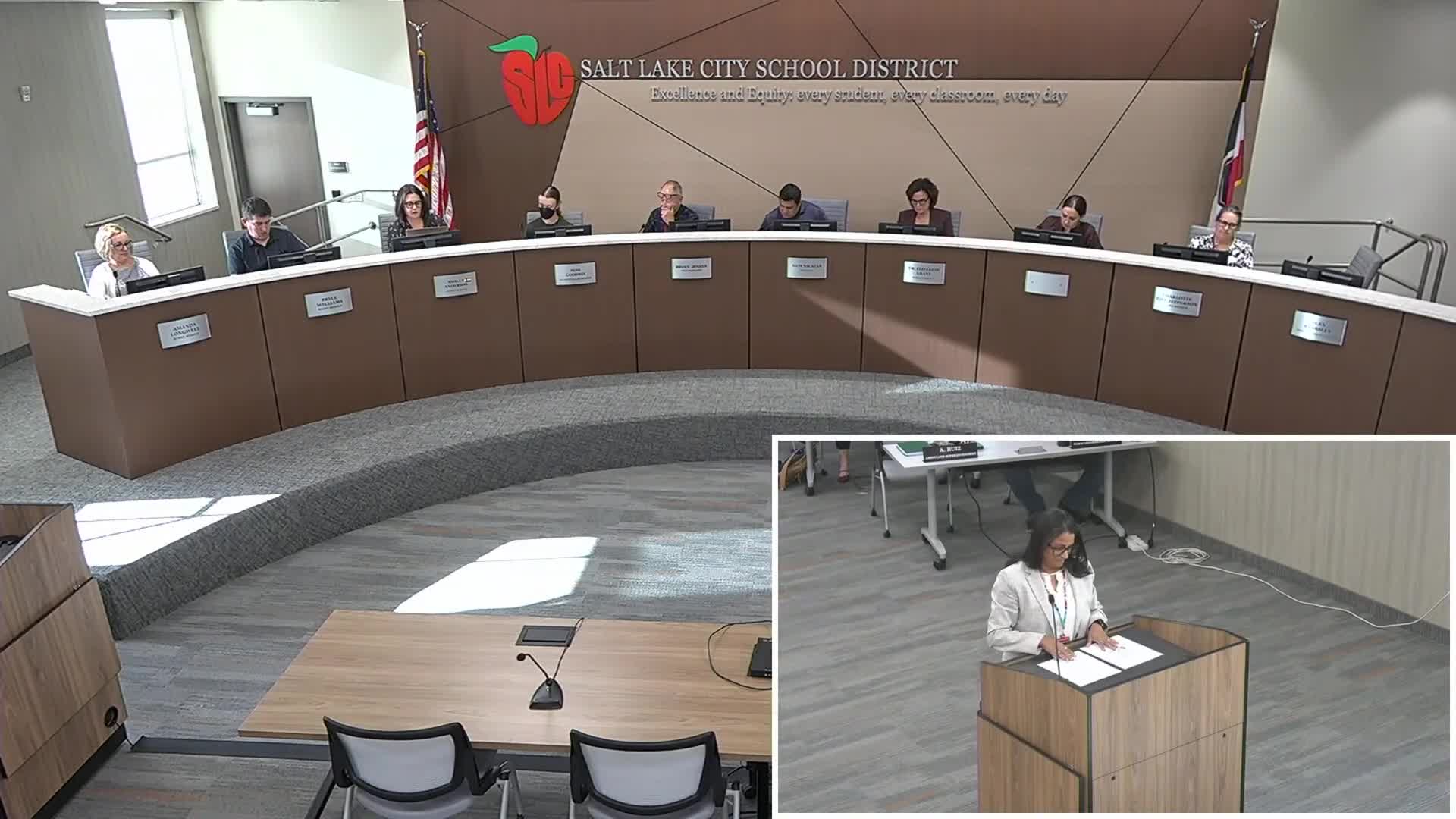
Summary
Board members raised concerns Sept. 16 that revised Strategic Plan language on career and technical education (CTE) could exclude International Baccalaureate (IB) students; staff said the portrait of a graduate is at an ideation stage and that the district will bring iterative updates.
Board members questioned proposed language in the Salt Lake City School District's updated Strategic Plan for Student Achievement on Sept. 16, saying the way a career-and-technical-education metric is written could inadvertently exclude International Baccalaureate students and create unintended pressure on some student groups. District staff said the plan is a "living document" and that changes will be brought back after further review.
Board member Amanda Longwell flagged a passage saying "students will complete at least 2 credits of advanced or career CTE coursework" and asked whether the language would exclude IB students who cannot schedule both CTE credits while pursuing an IB diploma. "I don't support an aspect of the strategic plan that would exclude some students when it's meant for all students," she said.
District staff responded that the plan's targets (for example, a 75% concentrator goal) are meant as stretch goals across the district and that the IB pathway itself is considered a college or career pathway. Doctor Hall (district administrator) said the district set goals by reviewing current participation and choosing achievable stretch targets for a five-year horizon. "We looked at where things are now and what seems achievable in five years," Doctor Hall said.
Separately, board members raised the "portrait of a graduate" concept. Doctor Grant said the district is at the ideation stage and noted the State Board of Education ran an institute to help districts develop local portraits; the district sent a team and will approach the work over multiple years. Board member Ashley Anderson and others asked that the board receive an update on the State Board of Education's portrait of a graduate work before the district pursues a local version.
Why it matters: strategic-plan language sets district priorities and measurable targets that guide staffing, budgets and program expansion. Ambiguous or exclusive language can create unintended consequences for specialized programs such as IB and for students with differing needs.
Discussion and staff commitments - CTE language and IB students: Board members asked staff to analyze whether the proposed language ("all students" completing two CTE credits) conflicts with IB scheduling and to reword the plan so it does not exclude IB students. Staff agreed to review the language and bring a clean revised copy for board consideration. - Data and targets: Several board members requested underlying data showing current CTE concentrator and completer rates (staff said concentrators currently are in the 20–30% range districtwide) so the board can judge whether targets are appropriately ambitious but achievable across student subgroups. - Portrait of a graduate: Staff described the work as multi-year, beginning with ideation and culminating in a community-informed product by a later strategic-plan iteration; staff said they will not implement a district portrait without bringing it to the board and that it would not change the current iteration of the strategic plan immediately.
Ending Staff agreed to return with specific edits to the CTE language, the data used to set targets and a plan to brief the board on the State Board of Education’s portrait of a graduate before significant district-level commitments are made. The board signaled it wants clearer implementation plans and resource summaries tied to the strategic-plan goals before approving final language.