
Committee splits over tree protections; some incentives advance, other proposals fail
Get AI-powered insights, summaries, and transcripts
Subscribe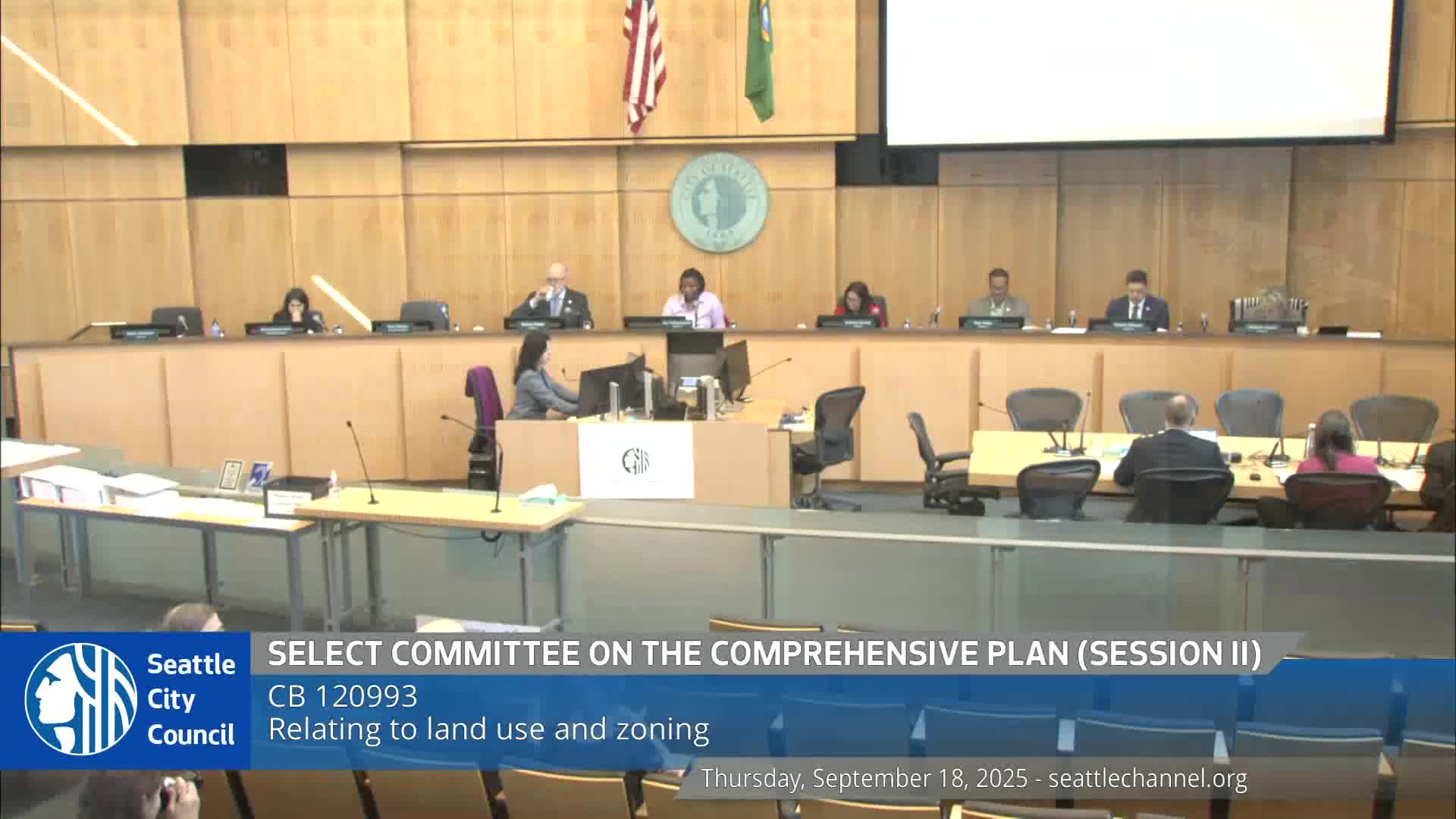
Summary
Council members debated multiple tree‑code amendments tied to the comprehensive plan. The committee adopted several incentives and minimums but rejected other measures, leaving larger tree‑ordinance questions unresolved and prompting calls for a dedicated follow‑up process.
The Seattle City Council’s Select Committee on the Comprehensive Plan spent much of Sept. 18 debating how the city should balance tree preservation with added housing capacity. Committee members considered a package of amendments affecting tree protection areas, minimum tree plantings, incentives for retention, and rules for historic‑district cladding and other items. The committee adopted several incentives and minimums but rejected other proposals, and members agreed to continue deliberations at a follow‑up meeting.
What the committee adopted and rejected
- Amendment 102 (sponsor: Council member Rivera) revised the definition of the “tree protection area,” allowed certain modifications based on species/health, and removed the earlier “basic tree protection area” construct; it passed on a 4–3 roll call. The change makes it more likely developers and property owners will engage an arborist early to calibrate exactly how much area a given tree needs, staff said.
- Amendment 100 (sponsor: Council member Strauss) established a minimum planting floor of one new tree per 2,500 square feet of lot area for neighborhood residential development when the TreePoint system otherwise would require fewer plantings; the amendment carried (final 5 in favor, 3 abstentions recorded) and became part of the proposed code.
- Amendment 104 (sponsor: Council member Strauss) offered site flexibility (reduced setbacks, reduced landscaping/amenity requirements) when large mature trees are preserved; it passed on a 5–3 vote.
- Amendment 93 (sponsor: Council member Rivera) proposed incentives (additional FAR and height and a 30‑inch minimum soil depth in planting areas) for lots that preserve certain trees; that amendment failed on an even‑split roll call (4–4), so it was not adopted.
- Amendment 103, which would have made protected large mature trees near lot corners effectively unremovable except for narrow exceptions, failed 1–7.
Why the debate was contentious
Council members and staff repeatedly said they share the goal of increasing tree canopy while also adding housing. Differences centered on three recurring themes: (1) the size and fixity of tree protection areas, (2) whether incentives should reward retention or allow alternative measures (for example, the “green factor” used elsewhere), and (3) project‑timing and permitting risk.
Council member Strauss argued that a non‑modifiable (fixed) protection area gives certainty to developers and avoids last‑minute surprises; Rivera and others said a species‑sensitive protection area, determined with arborist input, would preserve more trees in many real cases. Council member Kettle and others emphasized Seattle’s identity and the importance of preserving large evergreens.
Staff and technical details discussed
- Central staff described version changes and said amendment 93 included a soil‑volume requirement and would allow reduced setbacks, incremental 0.2 FAR bonuses and extra height to preserve trees. - Council member Rivera said she had removed an earlier provision that gave the SDCI director authority to require alternate site plans, after community feedback that that power could delay permitting. - Council staff noted adopted language relies on director rules and other parts of code for technical planting standards (for example, to ensure new plantings are in the ground and meet minimum sizing and mulching standards).
Votes and next steps
Several of the tree‑related amendments were adopted (including 100, 102, 104 and FAR/tree incentive 91), while others failed. Committee members and sponsors repeatedly called for a dedicated, technical follow‑up on the full tree ordinance: multiple council members asked for a separate process or docketing to review the tree code in depth and reconcile competing technical approaches.
The Select Committee postponed remaining comprehensive‑plan votes to a continuation meeting and scheduled further discussion of the code and outstanding tree issues for the committee’s next session.
Speakers quoted are members of the Seattle City Council and central staff who addressed the Sept. 18 Select Committee on the Comprehensive Plan meeting.