
Mayor's 2026 recommendation trims two 311 FTEs, credits IVR for shorter waits
Get AI-powered insights, summaries, and transcripts
Subscribe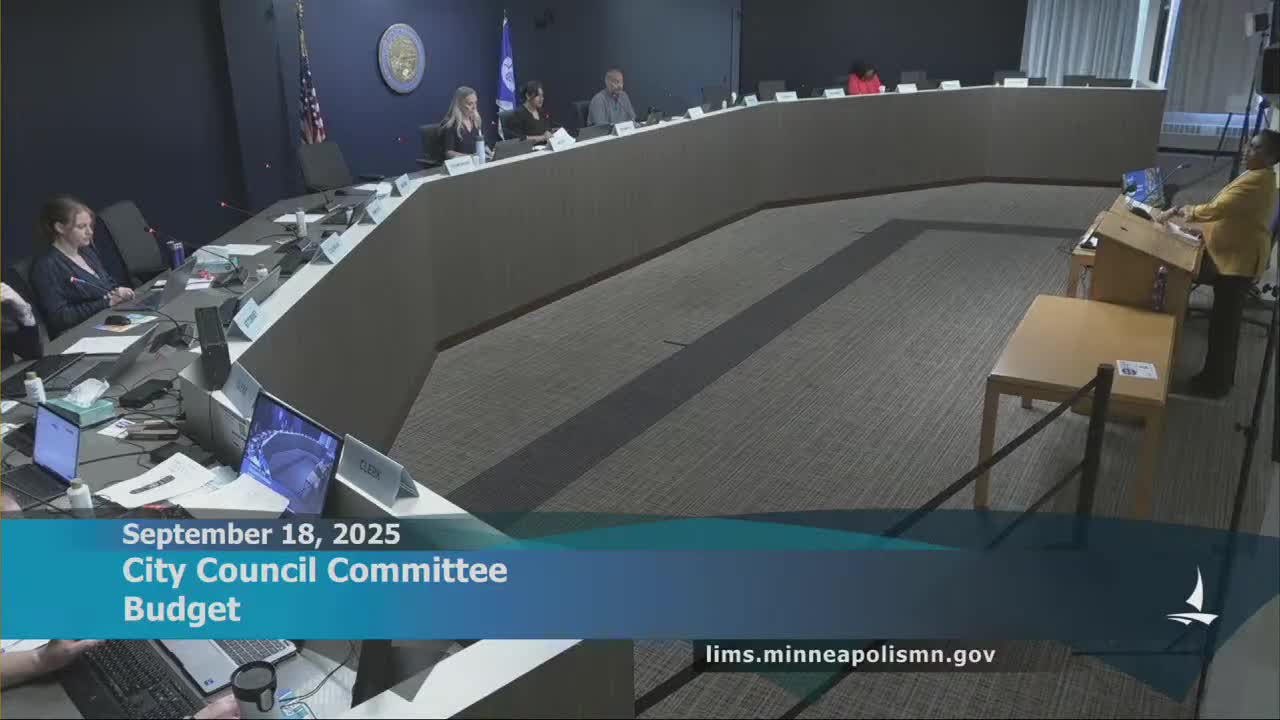
Summary
The mayor's recommended 2026 budget for the Minneapolis 311 Service Center shows a small net staffing reduction tied to delayed openings at a South Minneapolis safety center, while the department credits its interactive voice response system with sharply reduced wait times and lower abandon rates.
The mayor's recommended 2026 budget for the Minneapolis 3-1-1 Service Center would remove two unfilled positions tied to the delayed opening of the South Minneapolis Community Safety Center while projecting modest overall budget growth for the department.
Minden Nizimbi, the 3-1-1 service center director, told the Budget Committee on Sept. 18 that the department has 45 employees (43 paid through its budget and two temporary positions funded by Public Safety Aid at the Lake Street Safety Center) and that the recommended 2026 budget shows a net decrease of two FTEs because two South Minneapolis positions remain unfilled until that center opens. "These are proposed to be restored in 2027," Nizimbi said.
Why it matters: 3-1-1 is the city's main intake for nonemergency services and information. City officials said investments in the department's interactive voice response system (IVR) and training have reduced average wait times and freed agents for more complex calls.
Nizimbi said the IVR, which launched late in 2023, has resolved more than 100,000 of the roughly 361,749 calls that reached 3-1-1 in the first full year of operation. "Instead of adding multiple staff to keep up with workload trends, the IVR has absorbed much of that volume," she said. The committee was shown data the department said reduced average wait times from about 4 minutes in 2022 to 1.3 minutes in 2025 and cut abandon rates from nearly 15% to just above 3%.
Budget and operations details: The presentation said the department's overall budget grew by about 4.56%, roughly $308,962, driven primarily by higher internal service charges such as IT and rent. The recommended personnel change that realigns a manager and analysts to a lead analyst position was presented as FTE-neutral and estimated to save $14,260 annually "without reducing jobs or service levels," Nizimbi said. Two positions funded through Public Safety Aid at Lake Street are scheduled to transition to the South Minneapolis Community Safety Center when it opens. If the center opens before Jan. 1, 2027, the department said it could absorb a one-month funding gap.
Risks and technology: Nizimbi flagged the department's legacy CRM, Lagan, as outdated and costly to license and said a replacement CRM will not be implemented until 2027. She also said translation costs are increasing as the department expands services in more languages; the department currently relies on the city's master translation contract and recently hired bilingual Spanish and Somali staff to expand capacity.
Performance measures and community access: The presentation highlighted performance targets including a high rate of single-visit resolutions (95.33% as of Aug. 31, 2025, with a 2026 target of 96%) and improved approval rates for police reports entered by 3-1-1 agents (from about 97.19% in 2023 to 99.04% in 2025, with a 2026 target of 99.5%). Nizimbi also described the Lake Street Safety Center as a temporary local hub that served 335 residents through Aug. 31, 2025, and said outreach is underway to make residents aware of services available there.
Discussion vs. direction vs. decision: Committee members asked about additional tracking and benchmarking, translation technology, use of the IVR and its user experience, and what Lake Street service categories labeled "other city services" and "other outside services" include. Those questions generated discussion and explanations; the committee chair directed the clerk to file the 3-1-1 presentation at the conclusion of the item.
Next steps and context: Department leaders said they expect to finalize a CRM contract by the end of the year, start the CRM build in 2026, and continue to monitor translation costs and IVR performance. The presentation and its supporting dashboard were filed with the committee clerk for the record.