
Santa Fe planning commission reviews 500-page assessment for 'Santa Fe Forward' and begins visioning
Get AI-powered insights, summaries, and transcripts
Subscribe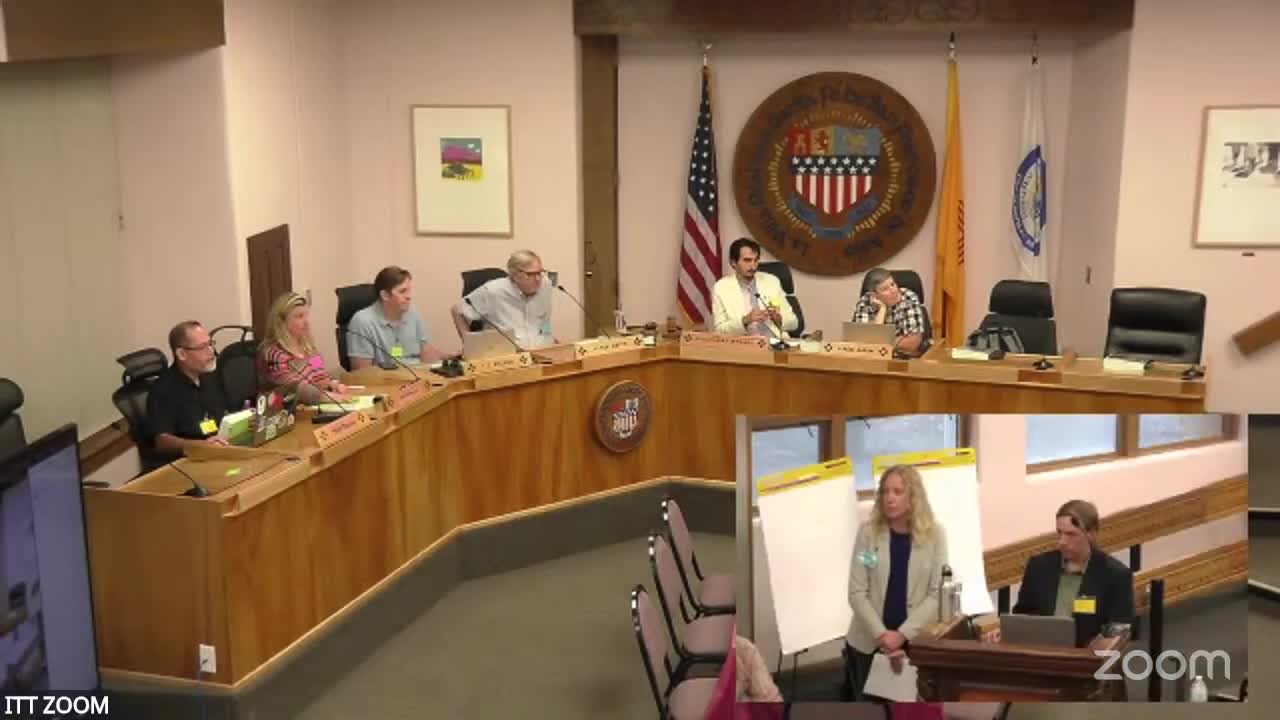
Summary
City planning staff and consultants presented the final assessment report for the Santa Fe Forward general plan update, reviewed key findings on housing, water, transportation and equity, described public outreach to date, and opened a commissioner visioning charrette; no formal policy action was taken.
The Santa Fe Planning Commission received a presentation on the final assessment report for the Santa Fe Forward general plan update and moved into a visioning charrette at a study session, with consultants from WSP and Leland Consulting Group outlining key findings and next steps. Janice Biletnikoff of the Planning and Land Use Department told commissioners, “this is a a major milestone to be celebrated that we are closing out stage gate 1 and entering into phase 2 of this process, which is the visioning phase of the general plan update.”
The assessment report, the consultants said, is an existing-conditions analysis of more than 500 pages that will inform scenario planning and the update of the city’s general plan — the first substantive rewrite since the plan adopted in 1999. “One third of Santa Fe households spend more than 30% of their income on housing,” task lead Amy DeCarantonio told the commission, summarizing a central affordability finding from the housing chapter.
Consultants described eight cross-cutting themes in the assessment: nature/climate/resilience; community services and governance; utilities and stormwater; housing and economic opportunity; multimodal transportation; history/culture/arts; the built environment; and community demographics. The team’s development-capacity analysis identified “over 5,000 acres of vacant land plus another thousand of underutilized land” for potential redevelopment, and an equity analysis flagged 11 census tracts as “equity communities,” the presentation said.
On population, Andrew Oliver of Leland Consulting Group described the forecast approach and limits. “It was mostly based initially on the state forecast,” he said, and the team then analyzed births, deaths and migration to produce low, medium and high forecast ranges; the medium forecast in the assessment shows growth through about 2040 followed by a plateau or decline, while the high-range forecast would still show continued, slower growth.
Commissioners and consultants discussed public engagement metrics and strategy. The team said the draft assessment was posted June 13 and a four-hour open house on June 14 drew more than 80 attendees. During the June 14–July 20 public comment period, the consultants reported 52 comments from an online forum and survey and several dozen in-person comments at the open house. The team also described extended outreach this summer: more than 30 hours of tabling at 13 events, about 196 in-person comments at those tabling events, roughly 70 project sign-ups from that outreach, bilingual radio ads, bilingual newspaper advertising in the Santa Fe Reporter and The New Mexican, flyers at 20+ public facilities, and a project newsletter with more than 1,000 subscribers; the consultants said the project website (santafeforward.org) had received over 10,000 visits and that the online comment total had grown to “well over 800” (possibly more than 1,000) overall. The team also described a community partners program that provides mini-grants to community organizations to broaden participation.
Several commissioners questioned sample size and distribution of outreach. Commissioners asked where tabling events had occurred and whether recommendations and studies from local advocacy and professional groups were being included; the consulting team responded that locations are listed on the project website, that events included multicultural and youth-oriented gatherings (for example Pride, a teen block party and a south-side back-to-school event), and that the technical working group and community partners program are being used to surface additional studies and recommendations.
The presentation identified several city-specific risks and opportunities noted in the assessment: long-term water risk and stormwater management needs, wildfire and drought exposure, gaps in multimodal active-transportation networks, declining school enrollment linked to affordability and demographic change, and geographic gaps in health-care access and other services, especially on the south and west sides of the city.
No formal policy or ordinance was adopted at the session; the meeting was a study workshop and concluded with a facilitated breakout visioning exercise for commissioners and technical working group members. Consultants said they will synthesize all notes, Post-it inputs and breakout results and deliver a high-level summary soon, with a fuller synthesis expected in late October; they said a vision document would follow later in the fall or early winter and that an implementation/action plan will be developed later in the process.
Documents and outreach materials are posted at santafeforward.org, the consultants said. The planning staff and consultants asked commissioners to continue participating in public-engagement steps and signaled additional study sessions and meetings ahead as the land development code update and general plan work move forward.