
Newsom signs package of California bills to limit immigration enforcement near schools, hospitals and public spaces
Get AI-powered insights, summaries, and transcripts
Subscribe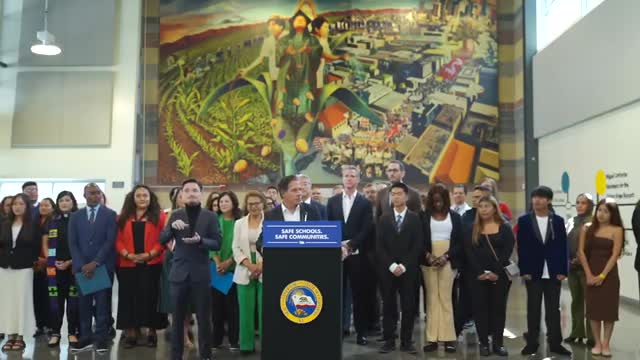
Summary
Gov. Gavin Newsom signed five bills at a Los Angeles event that supporters say will keep ICE off school campuses, restrict masked enforcement, bar secret-police tactics in hospitals and require notifications to families; four took effect immediately and the anti-masking measure is scheduled for Jan. 2026.
At an event at Miguel Contreras Elementary School in Los Angeles, Gov. Gavin Newsom signed five bills Wednesday that state leaders said will limit federal immigration enforcement near schools, hospitals and other public spaces and protect immigrants’ access to services.
The package includes AB 49, the California Safe Haven Schools Act, which authors and supporters said will bar ICE from school campuses and prohibit sharing student data with enforcement agencies. “Keep ICE out of our schools,” Assemblymember Al Muratsuchi, chair of the Assembly Education Committee, told the audience.
The measures also include SB 81 (protections for health-care settings and providers), SB 98 (notification to families when immigration enforcement is nearby), SB 805 (measures to prevent vigilante or unmarked enforcement activity) and SB 627 (an anti-masking provision aimed at forcing federal agents to identify themselves). Gov. Newsom said four of the bills go into effect immediately upon his signature and the anti-masking law will take effect in January 2026.
Why it matters: State and local officials framed the bills as a response to what they described as an uptick in aggressive, masked or unmarked enforcement actions that have sowed fear in immigrant communities and disrupted school attendance and health-care access. Los Angeles Unified officials described direct incidents involving students and families and said the district had implemented local protections such as legal-support funds, safe-passage zones and transportation to reduce fear about attending school.
Supporters cited specific harms. Los Angeles Unified Superintendent Alberto Carvalho said some children have been “yanked from our streets” and described a case of a 15-year-old who was handcuffed near a school; he added the district created a Compassion Fund to provide legal support to students and families. Los Angeles Mayor Karen Bass said the bills represent “legislative resistance” to federal actions she and others called abusive; State Sen. Lena Gonzalez and others listed the bills in the package and described measures to bar masked or secret policing.
State Superintendent of Public Instruction Tony Thurmond said AB 49 will also protect student data from being shared with ICE. Thurmond also thanked lawmakers for SB 98, which he said requires notification to families when enforcement is in the area.
Gov. Newsom spoke repeatedly about the bills as both a legal and moral response, saying the state would use its authority and moral voice to push back. He acknowledged the measures will face court tests: “We are clear in the legislation that judicial orders, or warrants provide an exemption,” he said, and added that the laws “will be tested.”
Who spoke and what they urged: Assemblymember Al Muratsuchi framed AB 49 as a guarantee of students’ constitutional right to education; Sen. Lena Gonzalez described a broader legislative package including protections for hospitals and prohibiting masked enforcement; Supervisor Hilda Solis and Mayor Karen Bass described economic and social effects they attribute to fear among immigrant residents; Tony Thurmond underscored data-protection and notification provisions.
Officials emphasized a mix of immediate protective steps the district and county had taken — family preparedness packets, workforce training, safe-passage zones and transportation — and the new statutory protections now on the books. They also warned the changes may be subject to legal challenge, and Newsom said the state is prepared to defend them.
The event was largely ceremonial: Newsom completed the formal action of signing the bills and took questions from reporters afterward about legal defensibility and coordination with other states. He repeated that the state had written exemptions for judicial orders and framed the package as likely to be litigated.
Ending: Supporters said the bills are intended to reduce fear that keeps children from school and people from seeking health care. Newsom and the legislative authors said they expect other states to follow California’s example and said the state would use legal and political channels to defend the laws if they are challenged.