
Provo school board reviews CAS gifted program data, parents favor neighborhood acceleration
Get AI-powered insights, summaries, and transcripts
Subscribe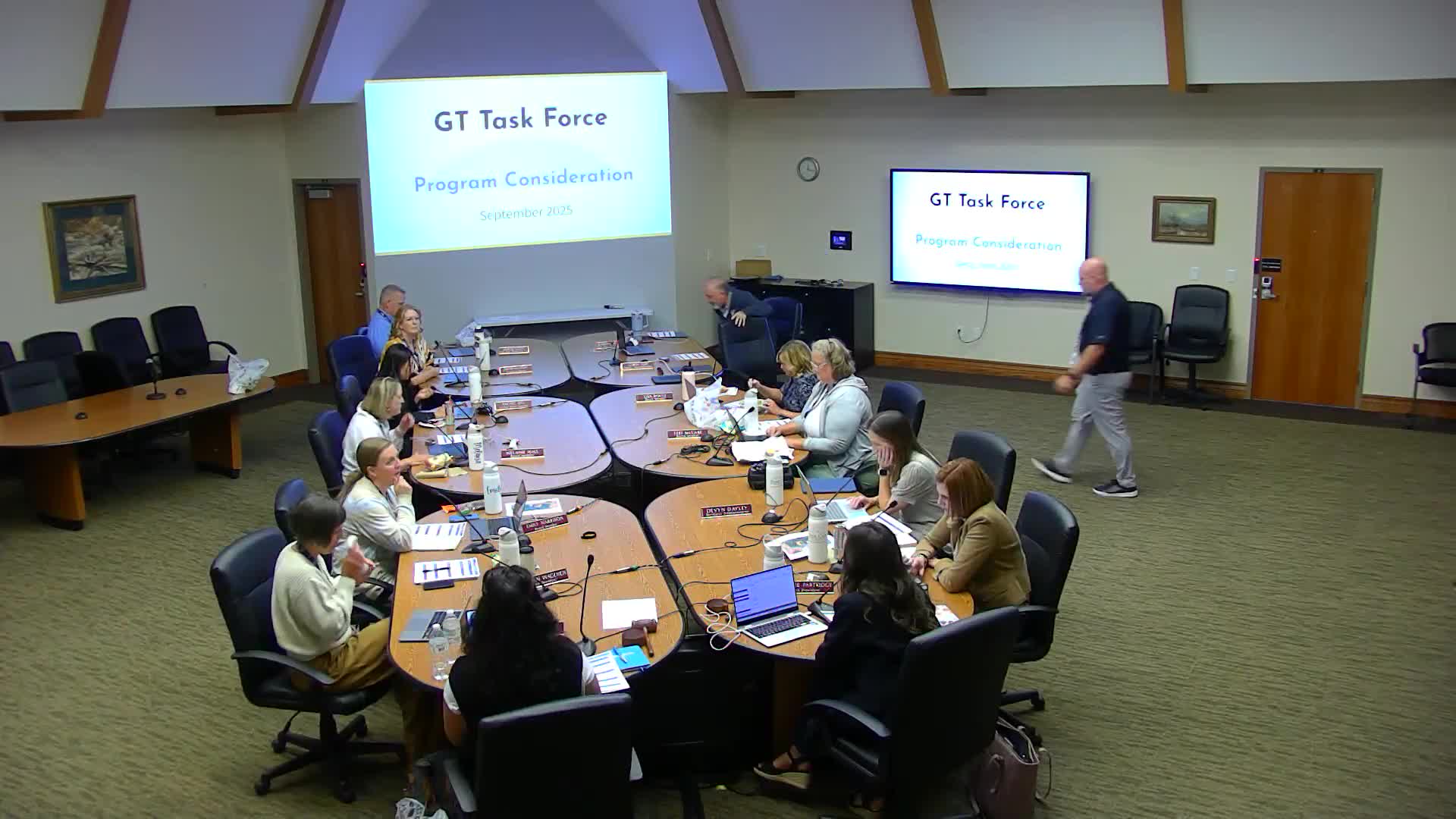
Summary
District staff reviewed a program evaluation of the CAS (accelerated) elementary gifted program, presenting survey results, draft models for keeping CAS as a magnet site or expanding acceleration into neighborhood schools, and cost estimates. Staff recommended a hybrid approach and staff were asked to return with more details.
The Provo City School Board on Sept. 19 heard an update on the district's CAS accelerated elementary program and draft options for improving access, curriculum and teacher supports. Judy Rose, the presenter on the program evaluation, summarized parent survey results, described two draft program models and outlined estimated costs and staffing implications.
The evaluation found that the average acceptance rate of students invited to CAS from 2020 to 2024 was 39 percent and that, based on RISE math growth measures, "students in CAS are not outperforming students who decline CAS in RISE math," Rose said. She also reported that, of the students who qualify for CAS, about "20% are in CAS, 20% are in DLI, and 60 percent are in neighborhood schools but not in DLI." Rose said 50 percent of current CAS teachers hold a gifted endorsement and half of teachers who teach accelerated seventh-grade math hold a level 2 math endorsement.
Rose summarized responses to a parent survey sent to fourth- through sixth-grade families: 72 fourth-grade, 74 fifth-grade and 74 sixth-grade parents responded. Of those respondents, 29% had declined a CAS invitation, 41% had never been invited, and 30% were currently attending CAS. When asked which model they preferred, 23% favored keeping the current CAS magnet model, 67% favored offering accelerated services in neighborhood schools, and 10% had no opinion; Rose said families in CAS were primarily in the group that wanted to keep the existing model while support for neighborhood-based options came mainly from families in neighborhood schools.
Board members pressed Rose and staff on implementation details. Rose recommended district-aligned curriculum, stronger teacher supports (including requiring or encouraging gifted endorsements and math endorsements for certain teachers), a district GT specialist to coordinate program design and evaluation, and clearer annual screening and identification processes. She described two draft models: (1) a unified district-supported CAS magnet model with stronger district direction, teacher endorsements and potential transportation to reduce inequities; and (2) a neighborhood-school model with a GT teacher leader at each school, regular district-led professional development, and flexible school-level designs to reflect differences between DLI and non-DLI schools.
Devin Daley, the district's business administrator, and Rose presented cost considerations: additional teacher full-time equivalents (FTEs) associated with CAS site classrooms (an estimated 1.5 FTEs at some sites), stipends for school-based GT leaders, possible transportation costs (estimated about $100,000 for a two-site CAS model and $50,000 for a one-site model), a district GT specialist (half FTE if CAS remains; full FTE if districtwide supports are required for all 13 schools), and curriculum/enrichment supplemental estimates (roughly $7,000 per school). Per-student annual cost estimates Rose presented were approximately $1,869 for the current two-site CAS model, $1,552 for a single-site CAS model and $838 per student under a neighborhood-school model if the program was scaled to serve more students; Rose cautioned those numbers depend on how many students would participate and whether the district covers transportation.
Board members asked Rose to provide more detail on specific items: student counts who would be served under each model, per-student cost calculations, how to phase changes so current CAS students complete existing pathways, and what district-level staffing/funding would be required. Rose said she recommended a "balanced approach": preserving a CAS option for the students who most benefit from a full-day accelerated program while expanding supports to help advanced learners in neighborhood schools; she urged district-level coordination and professional development regardless of which model the board chooses.
Board direction: the board asked Rose to work with Superintendent Wendy Dowse's team to refine a hybrid model, to produce more detailed cost and participation estimates, and to return to a future meeting with options and implementation steps. The board also asked staff to gather additional parent input at two CAS sites and at selected neighborhood schools where many families had declined CAS invitations, then return with findings.
The board did not take formal action on program adoption or budget allocations at the Sept. 19 study session; those would require future agenda items and formal board votes.
Looking ahead, staff will refine the models and cost estimates and present a more detailed plan that includes screening protocols, teacher endorsement timelines, and an implementation schedule if the board chooses to expand services into neighborhood schools or redesign CAS.