
Council reviews proposed Rogue Community Health lease for Talent Community Resource Center
Get AI-powered insights, summaries, and transcripts
Subscribe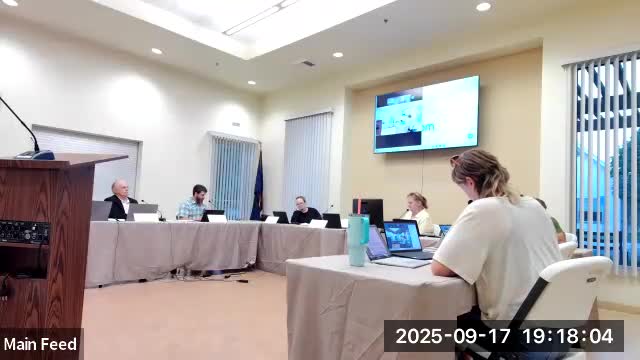
Summary
The Talent City Council and staff discussed terms and expected patient mix for a proposed lease with Rogue Community Health to operate the Talent Community Resource Center; no final lease was signed and council asked staff to collect additional patient-mix data from the existing Talent Clinic.
The Talent City Council discussed a proposed lease with Rogue Community Health for the Talent Community Resource Center at its Sept. 17 meeting, focusing on the proposed rent framework, service mix and how the move would affect low-barrier care in the building. City staff and Rogue Community Health’s CEO provided data on the health center’s patient mix and outlined operational plans; the council asked staff to obtain additional patient-mix data from the existing Talent Clinic before finalizing a lease.
City Manager Pro Tem Alex Campbell told the council staff had modeled a cost-recovery lease covering major long-term maintenance items and estimated a suggested rent of about $3,300 per month — roughly $0.93 per square foot — under a full-building lease in which the tenant would assume utility and routine maintenance costs.
Rogue Community Health CEO Calissa Warnecke said the health center typically serves a large share of patients on public insurance and low incomes: "About 75 percent of our patient population ... is basically on public insurance" and roughly "64 percent ... at or below 150 percent of the federal poverty line." She said community health workers, behavioral health and substance-use treatment could be brought to Talent under RCH’s model and that RCH cannot refuse care based on ability to pay.
Councilors pressed for more detail about how the migration of the existing Talent Clinic patient load would affect the share of clinic visits that meet the "low-barrier" intent of the community resource center. Warnecke said the two current Talent Clinic physicians would be employed by Rogue Community Health if the parties reach an agreement and that RCH expects to expand capacity there by adding support staff and additional clinicians, including behavioral health. She said patients would have a choice whether to remain with the providers if they joined RCH.
Council members also asked whether RCH would displace the Talent Clinic or local pharmacies. Warnecke said RCH does accept all insurances and already partners with local pharmacies; she added RCH’s stated intent was not to push existing providers out but to provide stability, broaden services and grow capacity in Talent.
Councilors expressed support for the concept but asked staff to obtain clearer data from the Talent Clinic about its current payer mix (Medicaid, Medicare, commercial, uninsured) and patient counts before the council takes a final lease decision. Council consensus was to continue negotiation and bring back a draft lease and the clinic data in a future meeting.
The discussion also covered subtenants: Rogue Food Unites (outdoor food distribution) and the Talent Food Pantry (Access) were discussed as possible building users; staff said Access had applied and been selected to operate a food pantry presence in the building and that the city and RCH would explore whether Access should have a direct lease with the city or be a subtenant of RCH.
Council direction: staff was asked to collect the Talent Clinic’s patient-mix and payer data, provide a copy of the draft lease to council, and return with details on how Access (the food pantry) and Rogue Food Unites might be incorporated into the building plan. No lease or final authorization was adopted at the meeting.
For transparency, the council noted timing pressures: the Talent Clinic’s current lease expires in December, and staff and RCH said talk continues about reaching a lease by October if the parties can resolve open questions.
What’s next: staff will return with the Talent Clinic payer/mix data, a revised draft lease, and recommended tenant/lease structure for council review.