
Council advances schematic design for Ultra Sports Complex Phase 2, approves four-court option
Get AI-powered insights, summaries, and transcripts
Subscribe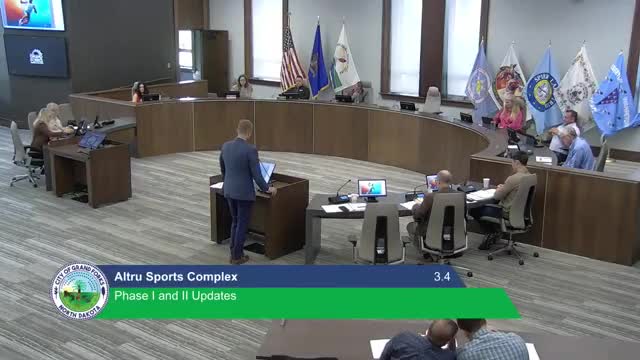
Summary
The City Council Committee approved advancing schematic design and preconstruction work for Phase 2 of the Ultra Sports Complex, favoring a four-court addition with an attached sports-performance space and directing staff to proceed to schematic design while raising operational and infrastructure-cost questions.
The Grand Forks City Council Committee of the Whole voted Monday to advance schematic design and preconstruction work for Phase 2 of the Ultra Sports Complex, approving staff’s recommendation to pursue the four-court option with a sports-performance training area and to proceed to schematic design. The motion was moved by Councilmember Berg and seconded by Vice President Weigel; the motion passed with one dissent noted.
City officials said the addition is intended to integrate with Phase 1 and expand tournament and training capacity. Staff presented two program options: a 60,000-square-foot, four-court addition with about 1,600 spectator capacity in tournament configuration and a 38,000-square-foot, two-court option that could be expanded later. City consultant Adam (GLG team) told the council, “we are really trying to be holistic and really creating an extension of the phase 1 project.” Cost consultant Oliver summarized high-level estimates and said, “we think that that facility can be built for for this amount,” while presenting a conceptual construction estimate of about $19.5 million for the four-court build and $13.7 million for the two-court alternative. The all-in, program-level budget targets shown to council were approximately $109.5 million for the four-court option and $103.6 million for the two-court option, against a city target budget of $110 million.
Council members and staff emphasized the need to refine estimates as design progresses. Staff said schematic design is expected to take roughly 10–12 weeks and that a first refined cost model should be available in January 2026. City Attorney Dan (staff) said the operations and management agreement with the Park District remains under negotiation and that staff plans to incorporate Phase 2 changes into a single agreement before presenting it for final council approval.
Park District representatives described how the project would affect operations. Park District representative George Elliot said the sports-training component is intended to consolidate existing rented space and generate revenue: “We do feel like that is a area of departure so you actually can make some money on this project with that sports training space. Again, it's about 10,000 square feet.” He told the council the Park District has budgeted for Phase 1 operating losses and is still developing Phase 2 operating projections.
Visit Greater Grand Forks told the council the complex could boost visitor spending from tournaments. Julie Regg said the Junior Grand Am event’s “direct spending alone brings in close to 3,000,000,” and argued an integrated, multi-court venue makes the community more competitive to attract multi-site events and multi-day tournaments.
Staff identified additional site infrastructure costs needed now to set up for Phase 2 and asked the council to accept a construction change-order estimate of $483,260 to extend water, sanitary, storm and pavement work and to relocate the contractor job trailer; staff said those costs are administrative change orders and will be charged to the relevant utility/fund accounts. The Park District told council Phase 1 operating losses are currently projected at about $370,000, and Phase 2 losses remain under development; Park District staff said they have budgeted for Phase 1 shortfalls but will finalize Phase 2 operating expectations by January.
Council members raised operational and equity questions during debate: whether youth user groups and school district partners will rent the new courts, how rental rates and schedules will affect local clubs that now use school gyms at little or no cost, and whether the community will need to cover ongoing operating subsidies. Several members asked for clearer operational modeling and user-group commitments before final construction approvals. Supporters said keeping design and bid scheduling moving forward preserves the opportunity to capture favorable market conditions and to keep the full project — courts plus turf and aquatics — aligned with the project voters approved earlier in the program.
The council approved staff’s recommendation to proceed to schematic design and to retain the construction management-at-risk team for preconstruction pricing and estimating. Next steps include schematic design (~10–12 weeks), a more detailed cost model in January 2026, potential design-development work if that model is acceptable, and subsequent GMP (guaranteed maximum price) approvals at later council meetings. If councilors want to stop the project at any of the design checkpoints, staff said those stops are available before the city commits to construction.