Alma Elementary outlines literacy push: WIN time, Heggerty and UFLI interventions
Get AI-powered insights, summaries, and transcripts
Subscribe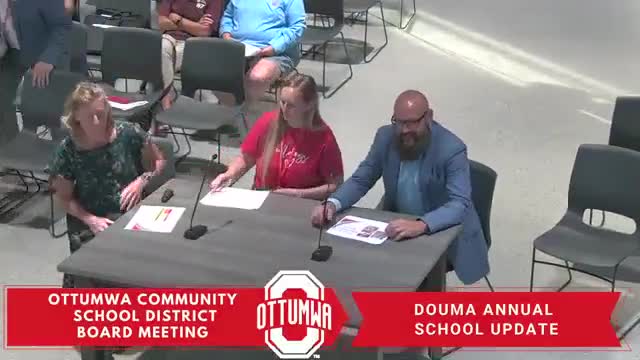
Summary
School leaders at Alma Elementary described a new WIN time rotation, screening with Heggerty and UFLI-based interventions, a data wall approach and goals for proficiency and aggressive growth; they also cited behavior supports such as a regulation room
Alma Elementary school leaders described literacy and behavior initiatives they said are intended to raise proficiency and accelerate growth after reviewing 2024–25 data.
Kim Hudson (school staff member) presented the building report. She said staff implemented a regulation room last year to provide short, supervised breaks for students who begin to dysregulate; the room is staffed by associates and the work left behind in classrooms follows the students back as an expected ticket out of the break.
On literacy, Hudson said the building screened all students using Heggerty and the Letters and Sounds phonics/word-reading inventories to pinpoint skills. Alma launched a school‑wide WIN time (small-group, targeted instruction) with a six-cycle rotation: five weeks of instruction followed by one week of assessment, with the sixth week reserved for building professional development and data wall sorting. Teachers received fidelity training on UFLI (University of Florida Literacy Institute) interventions for word reading and instruction aligned to science-of-reading practices.
Hudson described specific targets: the district literacy goal of 65 percent proficiency at or above benchmark on district reading assessments and Alma’s building goal to maintain 95 percent of benchmarked students (reported at 89 percent at the time of the update). She also said Alma set a building goal of 80 percent of students showing “aggressive growth” on district reading assessments and reported the current aggressive-growth rate was about 20 percent, with the district goal at 65 percent.
Hudson and staff said their short-term strategy is to focus on phonemic awareness deficits—work they estimated can be accelerated with roughly eight hours of targeted instruction per student—and then move students into decodable text and oral fluency work. Teachers are using ReadWorks decodable passages aligned to UFLI and exploring additional resources, including a Varsity Tutors AI-generated passage tool to bridge to full-text reading.
Staff said they will use a Google Classroom training site for onboarding and targeted re‑training and that mentoring and smaller-group interventions will support fidelity. A teacher asked to observe; Hudson invited the teacher to schedule a visit.
The presentation included regular checks on staff concerns and a building leadership team that will monitor Tier 1 implementation, reteaching needs and monthly teacher assessments.