
Cobb County lays out sustainability roadmap, warns county has no active landfills
Get AI-powered insights, summaries, and transcripts
Subscribe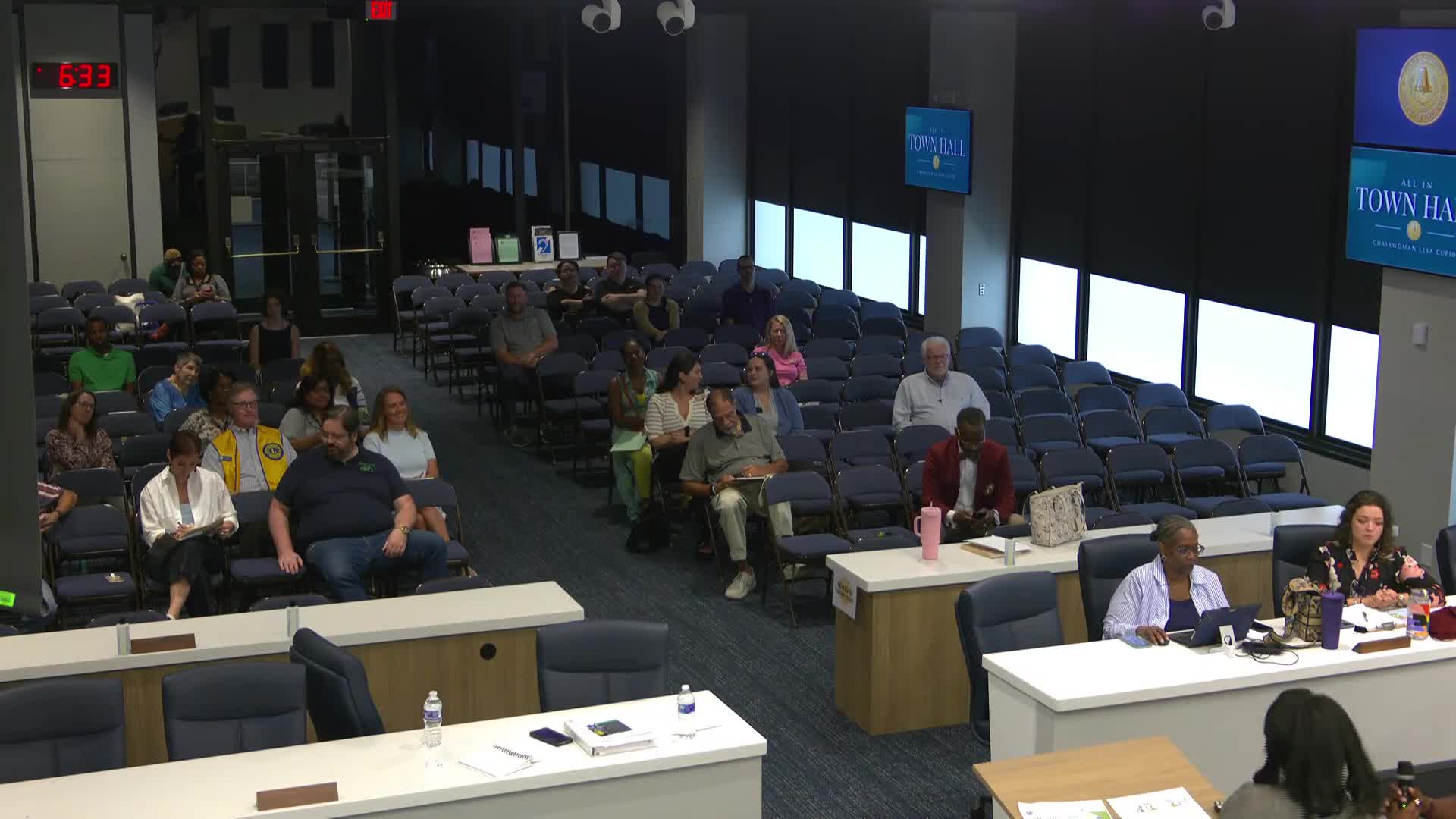
Summary
Cobb County officials described new recycling, composting and electric-vehicle efforts, announced a consultant-led planning process funded in part by an EECBG grant, and warned the county has no active landfills and relies on out-of-county disposal.
At a public Cobb County forum on sustainability, Chairwoman Lisa Cupid and Kimberly White, the county’s chief sustainability officer, described a plan of recycling expansions, electric-vehicle infrastructure and community programs while warning that Cobb has no active landfills and depends on out-of-county disposal.
Kimberly White, chief sustainability officer, said the office — formed in 2023 and staffed with nine people across four units — is focusing on a sustainability strategic plan, electric-vehicle infrastructure and a local “mini charm center” for hard-to-recycle items. "Pretty much that's what I do. I make sure that we all survive," White said during the presentation.
Why it matters: county officials said Georgia faces a national shortage in landfill capacity and that the state is at the low end of estimates for remaining municipal solid-waste space. White told the audience that research showed about 30 years of landfill space remains in Georgia and that "every single piece of trash that we throw away in this county gets transported outside of the county." Chairwoman Lisa Cupid added that some out-of-county disposal has in the past required shipments as far as Alabama, increasing greenhouse-gas emissions and costs.
Key programs and funding
- Energy Efficiency and Conservation Block Grant (EECBG): White said Cobb County received "over a half million dollars" from an EECBG award to support three priorities: build a sustainability strategic plan, update EV infrastructure and deploy a mobile, solar-powered EV charging station. The county also used grant funds to repair and reactivate public EV chargers.
- Recycling and the hefty renew program: White reviewed the county’s work with private partners and community drop-off sites. She highlighted the hefty renew program for hard-to-recycle plastics (plastics labeled 3–7) and said the county converted material collected through that program into a cinder-block-like material used to build the sign at the new recycling drop-off. White noted Cobb was an early adopter of the hefty renew curbside/drop-off program (the county launched a program in 2017) and that the program helped make some plastics into a commodity.
- Material recovery and market volatility: White showed commodity price swings for old corrugated containers (OCC) — $85/ton in 2021, $160/ton in 2022, $35/ton in 2023 and $110/ton in 2024 — to explain why recycling collection and processing costs vary. She said market swings and contamination can force processors to divert material to landfill.
Fleet and EV electrification
Al Curtis, director of fleet, described a decade-long move to alternative fuels and electrification. He said Cobb started fleet electrification in 2014, deployed 16 Nissan Leafs then, and now has "over 71 fully electric battery electric vehicles within the fleet" and roughly 180 hybrid vehicles in public-safety fleets. "We have over 71 fully electric battery electric vehicles within the fleet right now," Curtis said, adding that the county is pursuing solar, battery storage and a microgrid pilot with Cobb EMC to help manage charging and reduce peak costs.
Operational details and processing
Officials said Smurfit WestRock operates Cobb’s material-recovery facility (MRF) and that many county drop-off and curbside routes deliver material to a transfer station on County Services Parkway before it is moved outside the county. When asked whether materials brought to the drop-off are recycled, a staff member who identified himself as Steve said, "Anything that comes to the drop off center is gonna come across the line. So we are going to try to recycle everything that comes out." White and facility representatives added that contaminated loads (for example, trash or loose plastic bags) can force portions of a load to be sent to landfill.
Community programs and next steps
White outlined community-facing programs: household hazardous-waste (HHW) collection (an event scheduled for Oct. 18 at Jim Miller Park, registration required), a community recycling event Nov. 8 at Jim Miller Park, a new composting pilot for residents, pop-up drop-offs for neighborhoods and a senior-home beautification program scheduled for Nov. 14. She said the county is working with consultants (JCI and KPMG) to audit operations and lead public engagement: surveys, open forums and resident workshops to inform the sustainability strategic plan.
Questions and concerns raised by residents
During the Q&A residents pressed officials on several topics the county acknowledged but has not yet fully resolved:
- Tree replacement and the county tree fund: White described the county's "Cobb Tree Program," where developers that cannot replace cleared trees pay into a tree fund used for plantings at county sites, schools and parks. She said a climate assessment with Georgia Tech identified parking-lot canopy as an area for improvement and that code or policy adjustments will be considered in the coming code updates.
- Verifying hauler recycling claims and single-stream contamination: Residents asked how to confirm a hauler actually recycles material. White advised contacting the local MRF and noted that Smurfit WestRock receives and processes material for Cobb. She warned that loose plastic bags can tangle MRF equipment unless collected in the hefty orange bags.
- Accessibility and universal design: Speakers asked whether sustainability planning will explicitly include residents with disabilities (sidewalks, curb cuts, access to parks and transit). White and Chairwoman Cupid said the county has ADA processes and a transit advisory board; officials welcomed more strategic, proactive engagement and suggested interested residents can join advisory meetings and volunteer programs.
What was not decided
No formal ordinance or board vote took place at the forum. Officials described ongoing and planned activities, consultant work and community engagement; they did not adopt code changes or binding policy at the event.
Why this matters
Officials framed the work as both a service and a fiscal necessity: landfill capacity is shrinking nationally, markets for recycled commodities are volatile, and the county lacks an active landfill. White emphasized resident participation and cleaner recycling habits as immediate levers to increase diversion rates and slow the growth of landfill waste.
What's next
White said consultants will release resident surveys and host public forums to gather input for Cobb County’s first sustainability strategic plan; Chairwoman Lisa Cupid said the county will share those links in its newsletter and on social media. Residents were encouraged to sign up for the county newsletter for updates and to volunteer for upcoming events.
Sources and direct quotes in this article are taken from the public forum presentation and the question-and-answer session with Kimberly White; Al Curtis; Chairwoman Lisa Cupid; and staff and facility representatives identified in the forum.