
Advocates press for statewide office to review unsolved homicides, and public database
Get AI-powered insights, summaries, and transcripts
Subscribe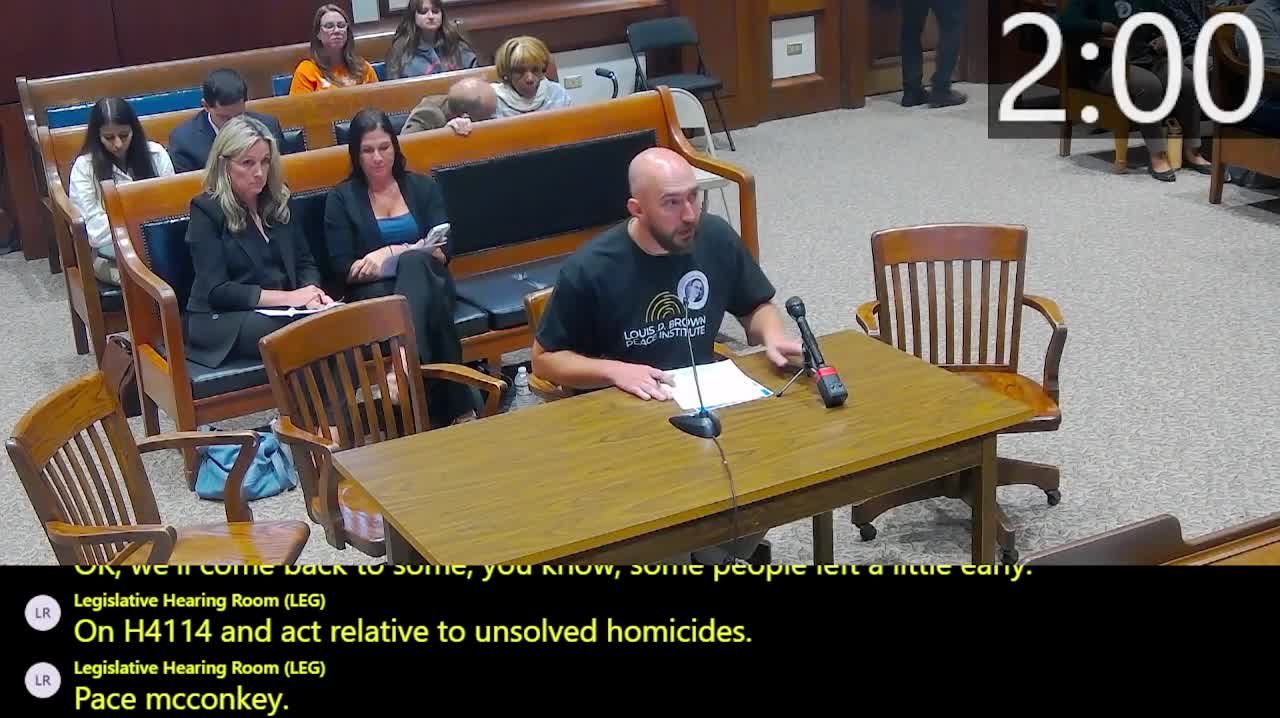
Summary
The Lewis D. Brown Peace Institute and survivors urged creation of an Office of Unsolved Homicides and a task force under the Attorney General to review cold cases, establish a statewide tip line and public database, and improve survivor communications.
Boston — Survivors and advocacy groups told the Joint Committee on the Judiciary on Sept. 21 that thousands of homicide cases in Massachusetts remain unsolved and asked lawmakers to create a statewide mechanism to review cold cases and improve communication with victims’ families.
Pace McConkie Jr., policy manager for the Lewis D. Brown Peace Institute, said more than half of homicides in the Commonwealth over the last 25 years remain unsolved and proposed H.4114 to create an Office of Unsolved Homicides and an Unsolved Homicides Task Force under the Attorney General. The bill would create a collaborative review process, a statewide anonymous tip line and a public database of unsolved cases, the witness said.
Natasha Carrington, who testified about the 2008 unsolved killing of her son Darien Carrington, described long periods without contact and said victims’ families frequently do not understand the status of investigations or victims’ rights. “Once a case reaches the 10‑year mark, it is classified as a cold case. I was never properly notified in 2018 that Darien’s case shifted to this status,” Carrington said.
Advocates said unsolved cases disproportionately affect Black and brown communities and that solving cold cases is itself a violence‑prevention strategy because unresolved homicides can fuel cycles of retaliation and trauma. The bill’s backers asked the committee to report the bill favorably, citing the need for standardized reviews and resources across municipal departments and DA offices.
Committee members asked about data sources and coordination between municipal police, state police and district attorneys’ offices. McConkie said the proposed office would bring stakeholders together, apply modern case‑review techniques, and provide families with clearer information about investigations.
No committee action was recorded at the hearing; advocates said they would continue outreach on bill language and implementation details.