
Prescott board affirms staff interpretation that hillside rules apply to subdivisions, not single-site build at 500 S. Marina
Get AI-powered insights, summaries, and transcripts
Subscribe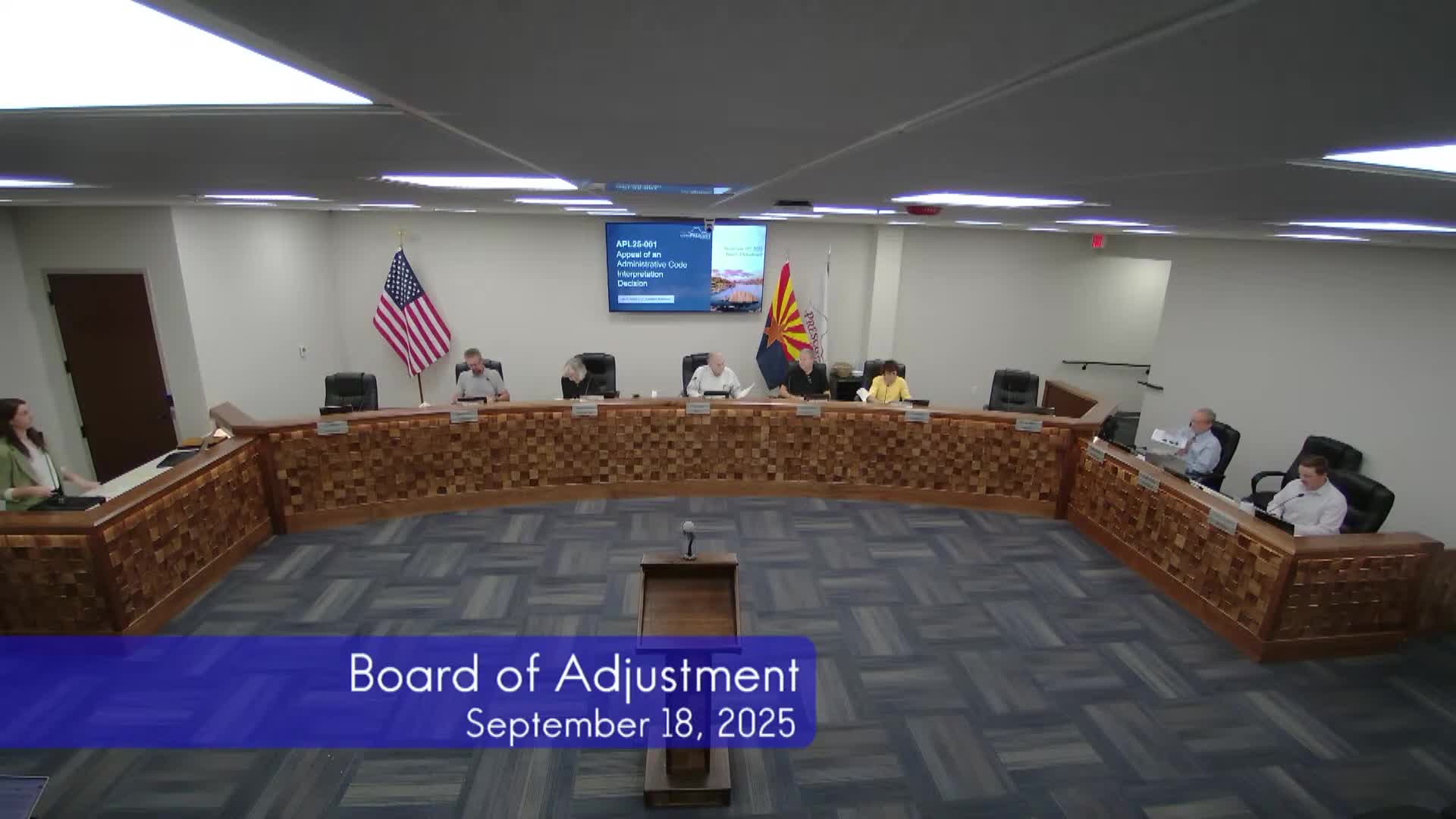
Summary
Prescott — The City of Prescott Board of Adjustments voted 4-1 on Sept. 18 to affirm the Community Development Director's interpretation that LDC §6.8 governs plats and subdivisions rather than single-site development, affecting a proposed project at 500 South Marina Street.
Prescott — The City of Prescott Board of Adjustments voted 4-1 on Sept. 18 to affirm the Community Development Director's interpretation that the city's hillside development standards (LDC §6.8) govern multi-lot processes such as preliminary plats and planned area developments (PADs) rather than single-site development, a determination that affects a proposed multi-unit project at 500 South Marina Street.
The board's ruling upheld Chelsea Walton, the community development director, after an appeal filed July 24 by Veronica Grace challenged staff's interpretation. The board considered legal arguments about the LDC's intent, testimony from nearby residents and engineers, and staff presentations about overlapping engineering and building-code protections.
The appeal centers on whether the specific wording in LDC §6.8 — which repeatedly references preliminary plats, PADs and subdivisions — creates an implicit exception that excludes single-site projects, or whether the broader applicability language elsewhere in the code (Article 6 generally) means the hillside standards apply to all site development. Grace argued the code's purpose — “Prescott Hills and Mesas are valuable scenic resources that should be considered for preservation” (LDC §6.8.0.1) — shows the drafters intended the hillside protections to apply citywide. In her remarks she said, “The intent of our code is to protect our hillsides.”
Walton told the board that, notwithstanding the dispute over §6.8’s applicability, ‘‘this project, and all projects throughout the city are still subject to engineering standards,’’ and that engineering, the International Building Code provisions, and other city standards address slope stabilization, drainage and safety for single-site construction. Walton said she sought legal counsel before issuing her interpretation and that the practical features of §6.8 — density transfers and on-site designation of natural areas — are aimed at multi-lot subdivision processes.
Board members split over statutory interpretation. Mary Frederickson, who moved unsuccessfully to reverse Walton's interpretation, said she focused on §6.8’s stated purpose and was concerned about allowing substantial hillside disturbance without invoking §6.8 protections. Mark Hokness, who made the successful motion to affirm Walton’s interpretation, said he deferred to staff expertise and the existing permitting and engineering review processes that apply to development.
Public commenters described environmental, safety and access concerns tied to the proposed Marina Street project. Neighbor testimony included an engineering-sourced slope map showing portions of the 500 S. Marina site averaging roughly 30–40 degrees; commenters warned that large-scale grading could increase runoff, threaten habitat and complicate emergency vehicle access on the narrow street.
Board action and votes: an initial motion by Mary Frederickson to deny (reverse) the director's interpretation failed for lack of four votes. A later motion to affirm the director’s decision on APL-25-001 (moved by Mark Hokness; seconded by Miriam Hobrick) carried 4–1. The board did not adopt any interim conditions or direct staff to withhold permits for the site; it affirmed the interpretation that §6.8, as written, does not automatically apply to single-site development in the way it governs subdivisions and PADs.
After the vote, several board members urged clearer code language. Mark Hokness asked staff to prepare a memo for City Council. Mayor-elect Kathy Rusing said she plans to place a review of the relevant LDC sections on a council study session agenda to consider clarifying language and avoiding future ambiguity. Walton said staff will prepare a memo and that the development remains subject to engineering and building-code review regardless of the board’s interpretation.
The board's decision settles the procedural question before it; it does not itself approve or deny any building permits for 500 South Marina. Any future permitting or development approvals still must comply with applicable engineering standards, IBC requirements, and other provisions of the LDC unless City Council acts to change the code.
Ending: The board’s deliberations highlighted a split over textual interpretation and local policy priorities; members asking for a council review means the matter may return as code-amendment language rather than as a permit decision. The appellant may pursue further administrative or legal options available under Arizona law if she seeks a different ruling on code applicability.