
St. Petersburg council asks administration to rethink sale of Science Center after public outcry and utility study
Get AI-powered insights, summaries, and transcripts
Subscribe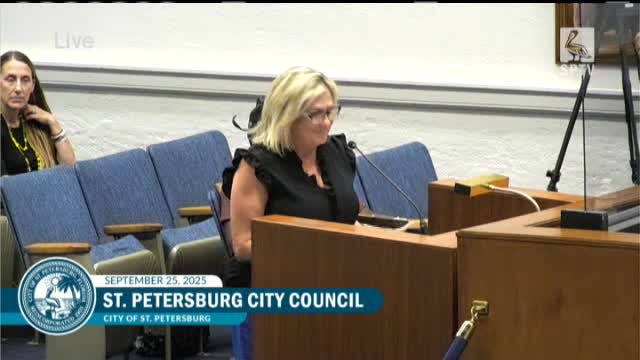
Summary
After hours of public testimony from West Side residents and a city feasibility study that flagged the site’s utility value, the City Council voted to ask the administration to reconsider plans for the St. Petersburg Science Center property and pursue the pending sale while exploring alternatives for stormwater/wastewater storage.
St. Petersburg City Council on Sept. 25 unanimously asked the administration to reconsider plans for the St. Petersburg Science Center site and to continue negotiations with the St. Petersburg Group while studying alternative locations for wastewater equalization or stormwater storage needs.
The council’s action followed more than two hours of public comment from West Side residents, neighborhood leaders and educators urging the city to preserve and reopen the Science Center — a long‑running educational facility — and after city staff presented a third‑party feasibility report that ranked several nearby sites for potential water‑treatment equalization storage.
Why it matters: The Science Center property at 7701 20th Ave. N. sits immediately south of the city’s Northwest Water Reclamation Facility. City real‑estate staff and public‑works engineers said the parcel is strategically located for future utility projects, while community leaders said the site is the only fully funded, ready plan for a West Side STEM hub that would serve thousands of children and bring state and federal grant money to the neighborhood.
Public testimony: Dozens of residents and neighborhood leaders implored council to reverse an administrative decision to pause the site sale and to relocate a brush/yard‑waste site instead of selling to the St. Petersburg Group, which proposed a privately funded Science Center renovation. “Save the Science Center,” said Jamie Hoke, a West Side resident and longtime advocate. John Hoke, president of the Council of Neighborhood Associations, told council the center “is an integral asset to creating good and great humans in Saint Pete.” Former educators, nonprofit leaders and a state senator described the center as a pipeline for STEM careers and cited millions in grant commitments already secured for programming.
What staff reported: Aaron Fish, the city’s real estate and property management director, reviewed the property’s acquisition and the grant and appraisal history. He told council the city bought the whole site in 2019 for about $3.2 million and later split the northern half for wastewater use and the southern half — roughly 3.89 acres — was appraised at about $1.5–$1.64 million in early 2023. Fish said the city transmitted a draft purchase agreement with the St. Petersburg Group in August 2023 with a proposed sale price of $1.6 million, subject to appraisals and standard closing contingencies. He also reviewed a renovation feasibility study that estimated building rehabilitation costs at roughly $3.5 million up to $9 million depending on scope.
Public‑works feasibility and the utility concern: Claude Tankersley, Public Works administrator, and consultants explained why the Northwest Wastewater Reclamation Facility commissioned a separate feasibility study, completed in draft in August and final in September 2025, to evaluate whether short‑term equalization (EQ) or wet‑weather storage tanks would be feasible and where they would fit most effectively. The consultant evaluated nine candidate sites and concluded the best long‑term footprints for future treatment expansion were (1) a parcel referred to as “site 4” on the plant south side, (2) the Science Center site, (3) the former Raytheon parcel, and (4) the brush site. Tankersley said the on‑site south area (site 4) scored highest because it is adjacent to existing treatment processes and therefore easier to integrate for future regulatory upgrades.
The report and modelling prompted staff to flag potential constraints on selling the Science Center parcel before first determining whether it is needed for wastewater resiliency. The feasibility work modeled storage volumes and costs; the study cited a planning‑level goal of at least 5 million gallons of EQ/wet‑weather storage and noted the practical and permitting complexity of siting storage tanks inside an urban utility footprint.
Council action and next steps: Councilmember Gina Driscoll moved a formal request that the administration “reconsider the plans for the Science Center site and move forward with the agreement with the St. Petersburg Group for the Science Center and work on alternatives for the public works uses in other locations.” The motion — intended to preserve the St. Petersburg Group’s sale agreement while directing staff to pursue other options for utility storage — passed unanimously.
Administration agreed to return with a status update at the Oct. 2 City Council meeting and to continue the feasibility, permitting and interagency outreach necessary to determine realistic timelines and permitting constraints, including coordination with the U.S. Army Corps of Engineers and state historic‑preservation requirements tied to federal grants.
Community context and funding: Supporters said the St. Petersburg Group had sought historic‑preservation accommodations required by the HUD grant process and that state and federal appropriations — including funds secured by state lawmakers and others — could be lost if the city does not move the transaction forward. Senator Daryl Rouson told council he had helped bring nearly $7 million in state funding to the effort over several years and warned that re‑securing appropriations is uncertain if the project stalls.
What council asked staff to do: The council’s unanimous motion preserves the buyer’s negotiated agreement while instructing the administration to pursue alternatives for any utility storage or EQ tanks that do not require this parcel; to continue engagement with the St. Petersburg Group and with federal and state permitting authorities; and to report back on a timeline for next steps.
Quotes (selected) "No further city funding is needed to make this happen…Let's ensure baby Harrison and every child can build, learn, and soar here." — Jamie Hoke, West Side resident "The property was a strategic acquisition…(to) serve two purposes: expansion of the northwest water reclamation facility and to ensure the city's brush site could remain on the property." — Aaron Fish, Real Estate and Property Management Director "We did this because we love science…we are aware of the irony that our love of science also runs up against our requirement to provide resiliency for our sewer system." — Claude Tankersley, Public Works Administrator
Ending: Council left the door open to both outcomes: the sale and reactivation of a funded Science Center and further study of alternative locations for sewer‑system resiliency. Staff agreed to return quickly with specific timelines and the results of ongoing permitting conversations that will shape whether both goals can be achieved without losing grant commitments or jeopardizing utility reliability.