
Commission hears extensive public comment on proposed Technology Overlay District; staff outlines standards, commission continues hearing
Get AI-powered insights, summaries, and transcripts
Subscribe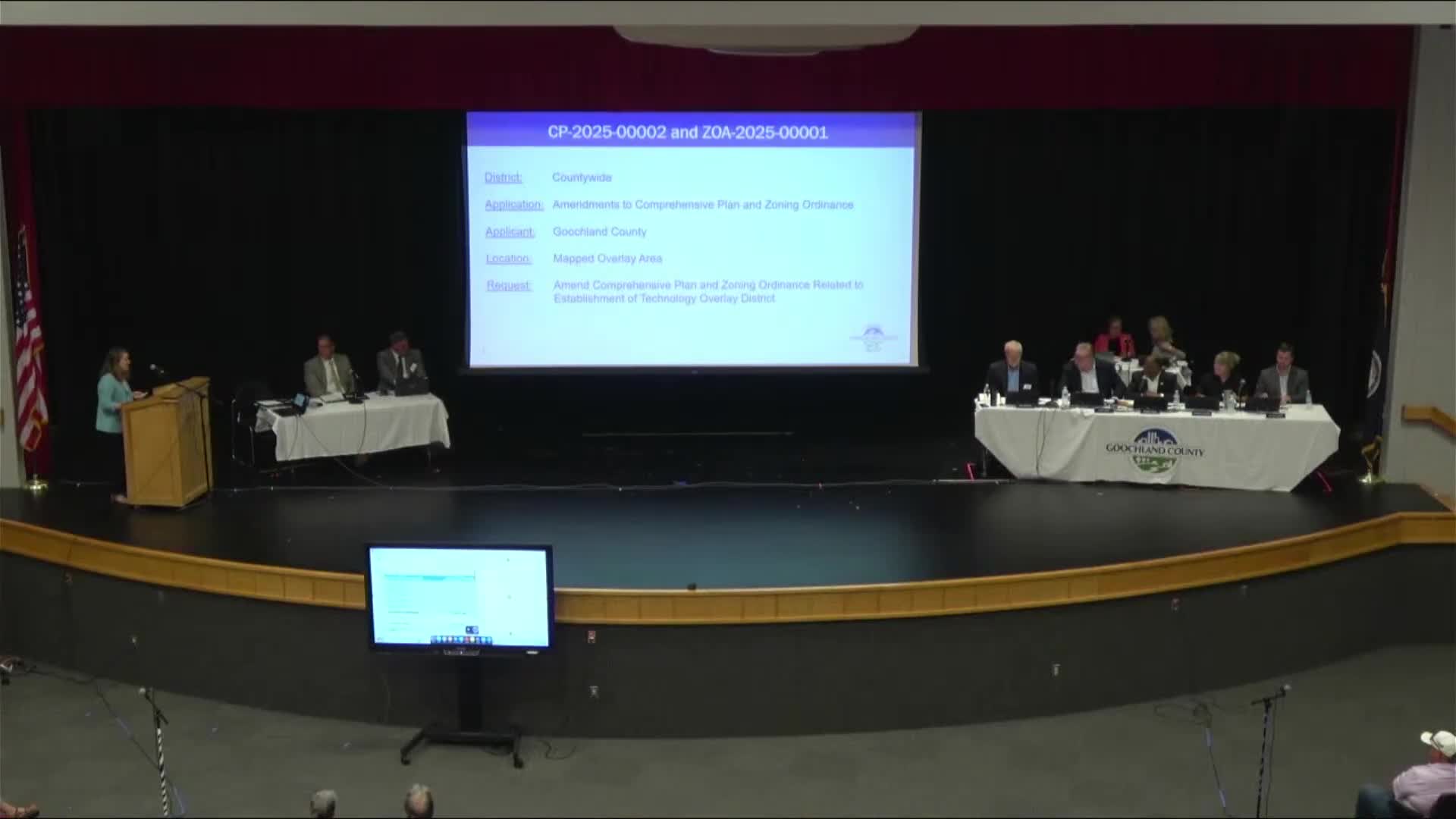
Summary
County staff presented a proposed Technology Overlay District and companion Technology Zone on Sept. 18; the Planning Commission continued the public hearing after hearing extensive public comment on noise, height, emergency power, and the inclusion of small modular reactors.
County staff presented a detailed proposal Sept. 18 to create a Technology Overlay District (TOD), a complementary Technology Zone for financial incentives, and an amendment to the 2035 Comprehensive Plan. The presentation by Sarah Worley, deputy county administrator for economic and community development, described where the TOD would apply, the uses it would allow, development standards intended to protect adjacent residential areas, and how the technology zone would provide incentive flexibility to attract high-revenue projects.
Worley said the TOD boundary was selected after county analysis of water, sewer, road, electrical and natural gas infrastructure and that the proposed overlay would cover roughly 2% of the county and about 21% of the county’s East End designated growth area. She said most land in the proposed overlay is already designated “prime economic development” in the comprehensive plan and much of it is already zoned industrial (M-1), including West Creek Business Park.
Worley outlined three elements of the initiative: the technology zone (a non-zoning ordinance that would permit financial incentives handled by performance agreements), the zoning ordinance amendments to establish the TOD, and a proposed comprehensive plan amendment to add “Technology Overlay District” as a land planning category. The technology zone would allow, for example, reduced utility connection fees when a return-on-investment calculation indicated a public benefit; Worley gave a hypothetical utility connection fee reduction from $2,000,000 to $1,000,000 as an example of the kind of flexibility that could be considered.
Worley said the TOD would permit technology businesses that are for‑profit enterprises deriving gross receipts from design, development, manufacture or sale of technology-based products or services, listing examples such as data centers and advanced manufacturing. The draft ordinance would also add definitions including “small modular nuclear reactor facility,” “natural gas peaking plant,” and “utility generating station.”
On development standards, staff proposed two development paths. Properties currently zoned A-2 (agricultural limited) would be allowed TOD uses only if they conform to TOD standards. Properties currently zoned M-1 (industrial), primarily in West Creek, could continue to develop under the base M-1 rules or opt into the TOD; opting into the TOD is how an owner could access technology zone incentives or seek building heights above the base limits without a conditional-use permit.
Worley described TOD protections that staff inserted after public comment: buffers and setbacks scaled by use and adjacent zoning, vegetative buffers to remain in a natural state (supplementation allowed but not removal), noise limits of 65 dBA daytime and 60 dBA overnight measured at any point within adjacent residentially zoned property, generator testing limited to two hours per day Monday–Friday between 10 a.m. and 5 p.m., limits on where energy storage and utility generating stations could be sited, and design controls for building massing and screening. Staff said data centers would require a 250-foot vegetative buffer and a 300-foot setback from residentially zoned properties, with increased setbacks required for taller buildings (up to 600 feet depending on height).
The proposal drew extensive public comment. Dozens of speakers—residents, engineers, health-care professionals and neighborhood representatives—urged changes or asked the commission to defer action. Common concerns included:
- Noise: multiple speakers urged lower limits than the draft (examples of requested limits included 45 dBA daytime / 40 dBA nighttime) and questioned the feasibility of ensuring generator testing and backup generators would not create prolonged high-level noise. Dr. Tim Staub, a retired biotechnology CEO, said, “60 to 65 decibels is about equal to a vacuum cleaner running right outside your backdoor 24/7.”
- Generator testing and backups: commenters warned that modern AI-focused data centers use many backup generators and that testing windows could produce sustained high noise. Speakers said testing frequency and sequencing could make the county’s 2‑hour-per-day testing allowance insufficient to prevent repeated loud events.
- Height and visual impacts: residents asked that by‑right heights be capped (proposed recommended caps included 80 feet), or that tall buildings remain subject to conditional-use review; several speakers said 120 feet is excessive next to residential areas.
- Small Modular Reactors (SMRs) and utility generation: multiple speakers, including nurses and health-care professionals, expressed alarm at adding SMRs by right in the definitions, citing lack of operational SMRs in the U.S., waste disposal concerns, seismic and quarry-blasting proximity, and potential health risks. Nurse Edita Pokosnik said peer-reviewed studies show an "increased risk of all cancers, thyroid cancer, and especially leukemia among residents living within 19 miles of [a] nuclear reactor," and urged the commission not to approve siting language without more study.
- Water, infrastructure and emergency planning: speakers noted local water constraints and asked how water use for cooling or SMR operation would be supplied and managed; others raised road and traffic capacity concerns.
- Process and equity: several speakers urged delay and additional study; others asked that data centers and large energy-generating facilities be subject to conditional-use permitting rather than by-right approval inside the TOD, to preserve public notice and hearings. Homeowner and HOA representatives requested stronger buffers (some asked for 300–600 foot buffers or a 1,000-foot buffer for data centers), limits on administrative waivers, and a property-value assurance program.
Staff acknowledged changes made after earlier community meetings—adjustments to setbacks, buffers, heights, noise and transparency—and noted a July community meeting followed by a larger Sept. 8 meeting with about 700 attendees. Worley said staff implemented community-requested modifications and that further public input would be considered as the proposal moves through Planning Commission and Board of Supervisors review.
After public comment the Planning Commission did not take a final vote on the TOD or the related comprehensive plan amendment. Commissioners moved to continue the public hearing to allow additional public participation and further staff review; the motion to continue the public hearing passed on a 4–1 roll-call vote. The continuation was scheduled for Thursday, Sept. 25, 2025 at 6:30 p.m. in the Goochland High School Auditorium, and the record remains open for speakers who did not present on Sept. 18.
No final zoning changes or incentives were adopted at the Sept. 18 hearing; the Planning Commission’s action was to continue the public hearing so that staff and commissioners can consider additional input and proposed ordinance refinements.
Representative quotes from the hearing:
- Sarah Worley, deputy county administrator for economic and community development: "The proposed TOD boundary encompasses around 2% of the entire county and about 21% of our East End designated growth area."
- Arnold Rosenberg, representing Mosaic at West Creek HOA: "We cannot be half community and half industrial park. We cannot be half a safe haven for families and half a sacrifice zone for economic development."
- Dr. Tim Staub, retired biotechnology CEO: "60 to 65 decibels is about equal to a vacuum cleaner running right outside your backdoor 24/7. The generators that kick on a couple times a day are 75 to 100 decibels, which is about equal to a lawnmower or a leaf blower every day."
- Edita Pokosnik, nurse: "There is an increased risk of all cancers, thyroid cancer, and especially leukemia among residents living within 19 miles of nuclear reactor. The risk is highest in children under 5."