
Judge denies defendant's motion to dismiss in Dixon County case; resisting count dropped
Get AI-powered insights, summaries, and transcripts
Subscribe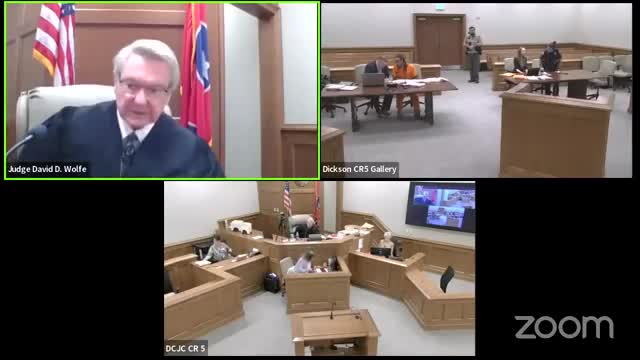
Summary
In a motion hearing in Dixon County Circuit Court, Judge David D. Wolfe denied Sherrick Vaughn’s motion to quash and suppress evidence related to Indictment 336, while the state voluntarily dismissed a resisting-arrest count. Corporal Lindsey Javins testified and video shown in court was admitted as an exhibit for the hearing.
Dixon County Circuit Court Judge David D. Wolfe on Aug. 20 denied pro se defendant Sherrick Vaughn’s motion to quash or dismiss and his motion to suppress evidence tied to Indictment 336, while the state voluntarily dropped a resisting-arrest charge, the court record shows.
The ruling came after testimony from Corporal Lindsey Javins of the Dixon Police Department and the partial playing of a patrol video. Corporal Javins testified that officers stopped the vehicle after a call reporting a possible domestic disturbance, that she asked Vaughn multiple times to step out, and that Vaughn later told her, "I'm a threat for a reason," while in custody at the jail. The defense played a 3 minutes, 6 seconds segment of the video and relied on that portion in argument; the court admitted the video as an exhibit for the motion hearing.
Why it matters: The court concluded there was sufficient probable cause for the matters the state intends to try on Indictment 336 — driving on a revoked license and a count of retaliation for past action — and denied the defendant's request to suppress or dismiss those counts. The judge found the evidence described at the hearing sufficient to send the retaliation allegation to a jury and rejected the defendant’s argument that any later statements were automatically tainted by an earlier, allegedly unlawful seizure.
The court's factual findings, as reflected in testimony, were: officers responded to a domestic-violence call, observed the vehicle arrive at Beasley Drive, asked the driver to step out and, after repeated refusals, physically removed him from the vehicle; deputies then discovered the defendant's license was revoked through dispatch checks and the defendant was transported and booked. Corporal Javins said she noted threats and later documented them in her report; grand-jury action added the retaliation charge after review of the investigative materials.
Defense arguments and court response: Vaughn — who has represented himself at the hearing — argued the initial detention ripened into an unlawful arrest, that Miranda protections should have applied once he was handcuffed and placed in the police vehicle, and that statements or evidence that followed were therefore "fruit of the poisonous tree." He also argued officers should have used citation-in-lieu-of-arrest options for a driving-on-revoked matter.
Judge Wolfe rejected those legal arguments at the hearing, citing Tennessee criminal statutes and state case law and explaining that probable cause for arrest is a lower standard than proof beyond a reasonable doubt. The judge also cited the Tennessee Rules of Criminal Procedure when addressing a separate procedural request and said, "There is nothing in that rule that requires the state to file a written response to your motion to suppress," when overruling a judicial-notice request earlier in the hearing.
Scheduling and other motions: The court confirmed the trial for the indictment the state elected to try first remains set for the week beginning next Thursday; several other motions and related charges were deferred and will be reset for additional motion hearings so the parties can produce witnesses. The court noted the state had produced discovery (printed copies delivered to the defendant in custody) and denied, without further relief, motions seeking recusal of court staff that the judge said he previously had denied.
Evidence and exhibits: The court marked the played video segment (3:06 minutes) as an exhibit in the suppression hearing. Corporal Javins’s report and her in-court description of statements she attributed to Vaughn were the primary evidentiary bases introduced by the state at the hearing.
What remained after the hearing: The court dismissed the resisting-arrest count (the state elected not to proceed on it) but left the driving-on-revoked and retaliation-for-past-action counts to be tried. The judge instructed counsel and the defendant to coordinate witness availability for later motion hearings and trial scheduling.
Courtroom procedure and counsel: The record reflects the court appointed an advisory "elbow" counsel role for Mister Spratt to advise Vaughn; the judge reiterated that advisory counsel may consult but may not independently examine witnesses unless allowed by the defendant. The court said it retained discretion over continued appointment of advisory counsel beyond the upcoming trial.
Corporal Javins and Jennifer Tozier were identified and testified/appeared as witnesses. Several other motions the defendant filed were discussed (motions for copies of records, preservation of testimony, subpoenas) and the judge ordered clerical steps (copies, subpoenas) to be completed so the hearings can proceed.
Ending: The court closed the hearing by scheduling follow-up motion dates and confirming the trial path on Indictment 336, while admonishing parties to arrange witnesses and exhibits for the subsequent motion sessions.