
Palm Bay council approves one zoning change but denies companion comp‑plan amendment for proposed Sankofa townhomes
Get AI-powered insights, summaries, and transcripts
Sign Up Free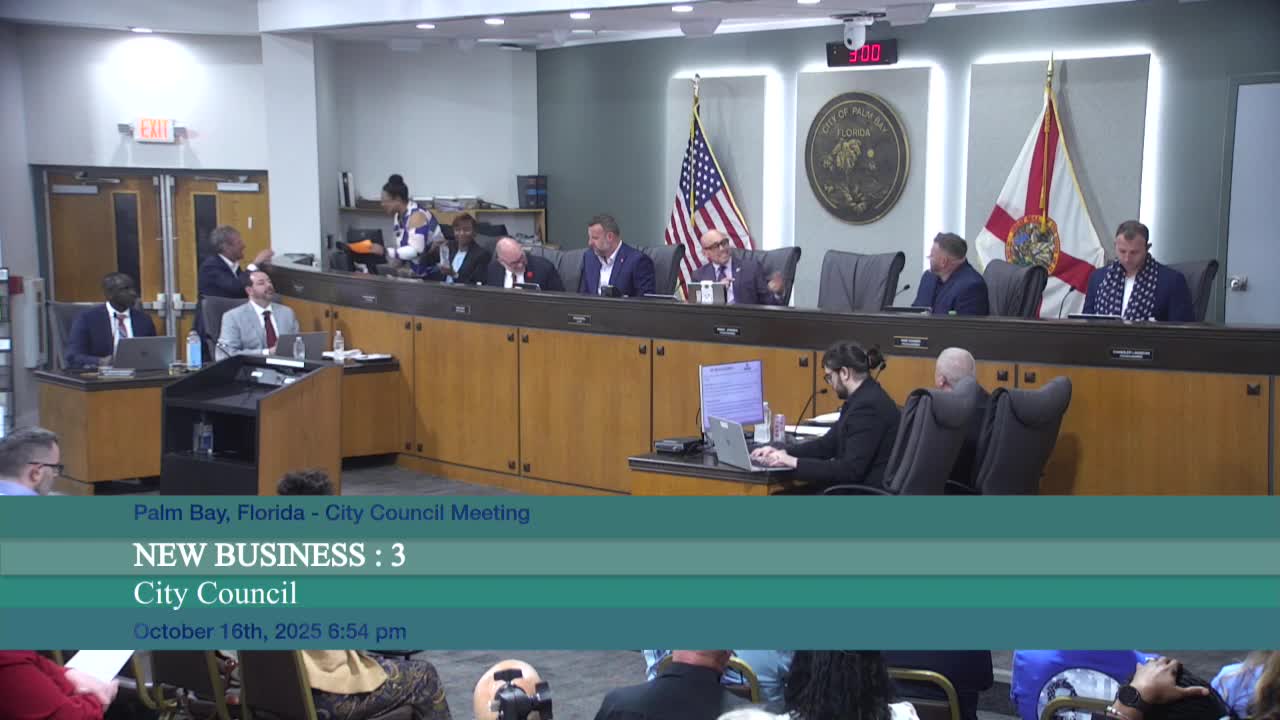
Summary
Palm Bay’s City Council approved a zoning map change for annexed property but voted 5-0 to deny a separate comprehensive‑plan amendment that would have allowed a proposed townhome development to build up to 116 units on an 11.66‑acre site.
City Council members on Oct. 9 approved a zoning map amendment for property annexed into Palm Bay but later declined a companion comprehensive-plan change requested by the same applicant, effectively limiting how a proposed townhome project can proceed.
At the start of the public hearings the council voted 5-0 to adopt Ordinance 2025‑48, changing the zoning of a parcel annexed into the city from county designations to RS3 (a residential zoning) with a condition that the developer execute a transportation impact fee (TIF) agreement before certain approvals. Deputy Mayor Jaffe made the motion; Councilman Hammer seconded.
Later in the agenda the council considered Ordinance 2025‑41, a proposal to change the property’s future land‑use designation from public/semi‑public (PSP) to moderate-density residential (MDR) for an 11.66‑acre tract where the applicant proposed up to 116 townhome units. Staff recommended a lower-density alternative, and the Planning & Zoning board had recommended against the applicant’s requested MDR designation. After multiple hours of public testimony — largely opposing the change because of traffic, drainage, school capacity and compatibility with single‑family homes — Councilman Langevin moved to leave the future‑land‑use designation unchanged. The motion carried 5-0.
Developer representatives and consultants said the project would extend water and sewer to the parcel at the developer’s cost, bring impact‑fee revenue and add housing choices described as "missing middle" (attached single‑family townhomes). Consultants for the applicant presented a traffic memorandum calculating roughly 55 a.m. peak‑hour trips and about 66 p.m. peak‑hour trips from full build‑out and concluded the project would not create significant traffic impacts under the city’s analytical thresholds. The applicant also provided a school concurrency review that, using adjacent school service areas, concluded capacity could be accommodated per the interlocal agreement with the school board.
But dozens of nearby residents told the council the project is incompatible with surrounding one‑story single‑family neighborhoods; they pointed to narrow local streets, frequent flooding following recent rains and nearby school capacity constraints. Several speakers said the Planning & Zoning board had voted against the project earlier. Retired engineers, residents and neighborhood leaders criticized the traffic and drainage analyses and urged the council to preserve the existing land‑use designation.
With the land‑use change denied, the developer’s options are constrained. The denied comprehensive‑plan amendment means the site remains designated PSP and cannot be developed for the higher‑density townhome plan without further land‑use action. The council’s earlier zoning vote (Ordinance 2025‑48) and its stated condition — a TIF agreement — mean any future application will be evaluated against that requirement and existing comprehensive‑plan rules.
Council members framed their votes around compatibility and the scope of city staff analysis. Acting growth management staff told the council the statutory definition of "urban infill" requires public facilities to already be in place; staff said this parcel required water and sewer extensions and therefore did not meet a narrow definition of infill. Council members who voted to deny the comp‑plan change said they were responding to Planning & Zoning’s recommendation, resident concerns and perceived traffic and drainage risks.
The city did not approve a site plan at the meeting. Developers said they would continue to work with staff; any future application for plan amendments, site plan approval, or platting will require additional technical reviews, transportation analysis and, if necessary, mitigation measures or impact‑fee payments.