
Waukesha transit shrinks service hours; Metrolift ridership surges
Get AI-powered insights, summaries, and transcripts
Subscribe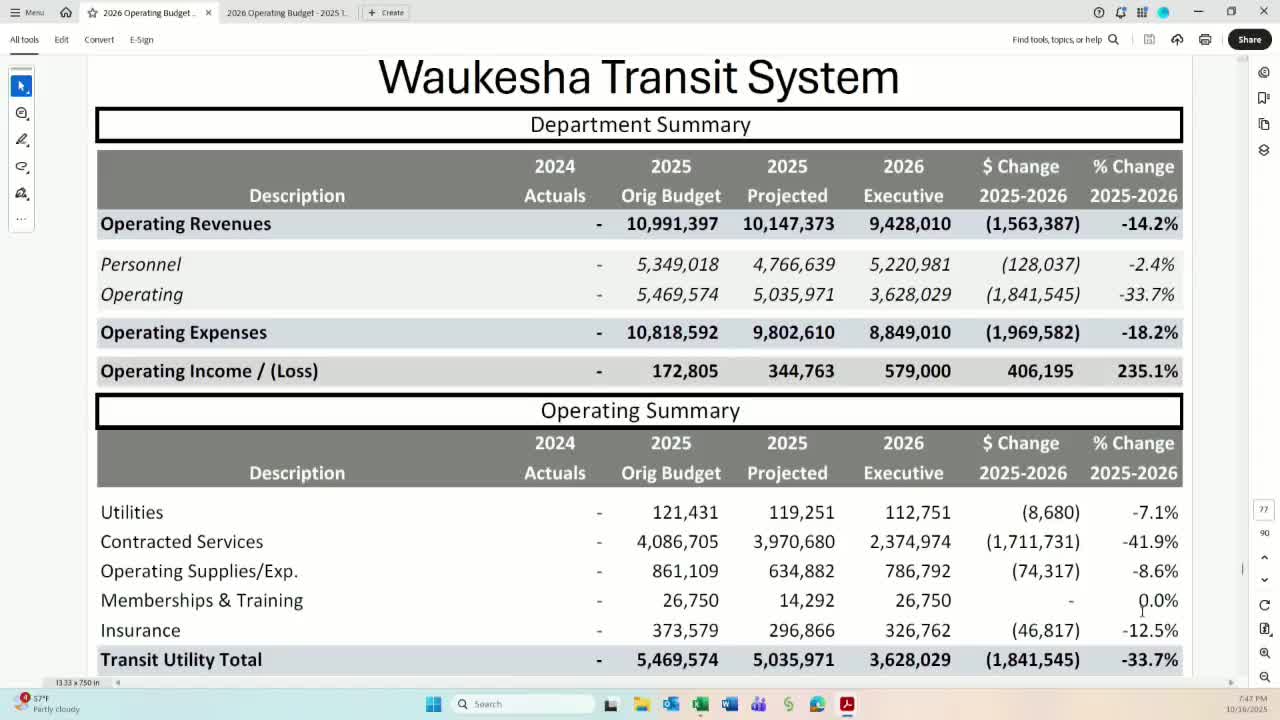
Summary
The city’s transit manager told the finance committee the system consolidated routes and cut service hours about 15% this year to match ridership and funding; the city’s subsidy has fallen to about $1.27 million while Metrolift demand has risen sharply.
Transit management reported on Oct. 16 that the city’s fixed-route transit system consolidated routes, reduced service hours and is managing changes in ridership and funding.
Transit staff said the system consolidated from 10 to 8 routes in June and cut roughly 15% of service hours; despite service reductions the Passengers Per Revenue Hour metric improved, rising from about 6.3 in COVID years to 8.4 year-to-date and about 9 from June through September. The manager said those efficiency gains have helped hold ridership roughly steady on fixed routes.
At the same time, Metrolift demand has increased dramatically: staff said Metrolift ridership is “the highest total since 2013” and up roughly 47% over three years. Transit staff warned that Metrolift growth is a cost driver requiring more service capacity.
Finance staff noted the transit program’s total executive budget figure on the presentation was $8.85 million, but clarified the city’s direct subsidy for transit is about $1.27 million—the lowest city subsidy level since 2010—because county, federal and other funds are mixed into the overall service budget. The manager explained fare recovery is limited: fares cover roughly 10–12% of operating cost.
Committee members discussed service impacts; transit staff said further reductions would be possible but would have “real world impacts on our passengers” and noted the system has used federal and ARPA funds in recent years to support operations. Staff said ARPA funds remain but are being drawn down and may be exhausted in early 2026.