
Planning board approves rear-setback variance at 1600 DeWitt Street for home addition
Get AI-powered insights, summaries, and transcripts
Subscribe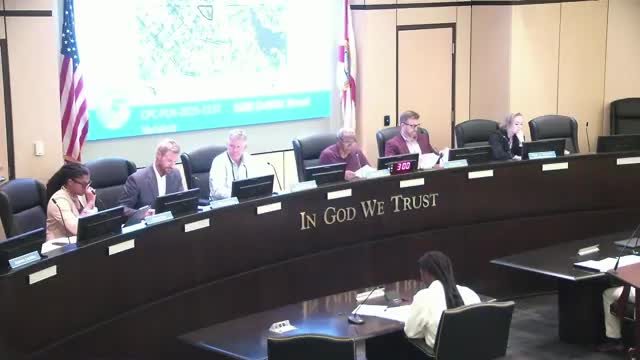
Summary
The Panama City Planning Board unanimously approved a variance reducing the rear setback from 20 feet to 10 feet 4 inches at 1600 DeWitt Street so the homeowners can build a covered outdoor addition.
The Panama City Planning Board voted 3-0 to grant a variance allowing a rear building setback of 10 feet 4 inches, rather than the standard 20 feet, at 1600 DeWitt Street. The variance would permit a 221-square-foot addition to an existing single-family home to provide covered outdoor space, according to the application.
Development Services staff told the board the property’s irregular lot shape presents unique circumstances and that, after review, staff found the applicant satisfied the five criteria for a variance under the land development code. Staff recommended approval. The application identifies the property in the R-1 zoning district; staff said the requested 10-foot-4-inch setback would not undermine the residential future land use category and would preserve building separation in accordance with Florida Building Code.
The applicant, identified in the hearing as Miss Gregg, told the board she had been surprised to learn of the large setback for the lot and said the addition would restore shaded outdoor space lost during Hurricane Michael. She said the proposed work would not extend beyond the existing carport’s footprint. When asked, Gregg confirmed the addition would build out to the same distance as the current carport.
Vice Chair Barker and Board members Carroll and Rich voted in favor during a roll call vote. There was no public opposition at the hearing.
The board approved the variance on a 3-0 roll call. Staff noted the approval was based on the variance criteria in the land development code and the lot’s irregular shape; no further administrative steps were specified during the hearing.