
Goodhue County presenter outlines 'Towards Zero Deaths' traffic‑safety efforts to Cannon Falls council
Get AI-powered insights, summaries, and transcripts
Subscribe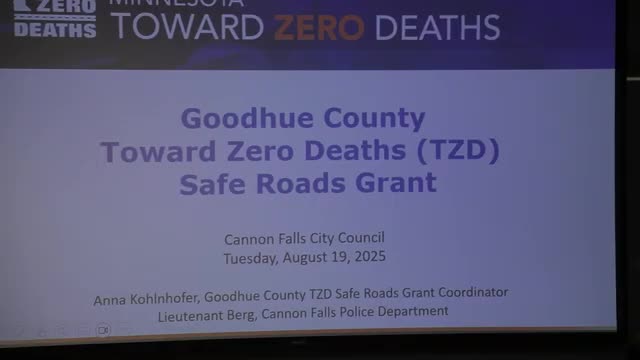
Summary
Anne Crawford of Goodhue County Health and Human Services presented county traffic‑safety data and local programs tied to the 'Towards Zero Deaths' initiative, noting a multi-pronged approach and targets to reduce fatalities in 2025.
Anne Crawford, community health specialist with Goodhue County Health and Human Services, briefed the Cannon Falls City Council on the county’s Toward Zero Deaths traffic‑safety program and associated local activities.
Crawford said the program aims to make traffic fatalities and serious injuries unacceptable by using data, best practices and a coordinated “five E’s” approach: enforcement, engineering, education, emergency medical/trauma services and everyone. "Last year in Minnesota alone, there was 477 fatalities," Crawford said, adding that nearly 30,000 people were severely injured and that the program seeks to reduce those totals.
Crawford highlighted county‑level trends showing a decline in fatalities since the program’s implementation and described targeted summer enforcement paired with education during the so‑called “100 deadly days” from Memorial Day to Labor Day. She told the council the county’s 2025 target is 225 crash‑related deaths and that local enforcement, school mock‑crash demonstrations, seatbelt demonstration events and ATV safety outreach are among activities intended to reduce serious crashes.
She described partnership work with schools (mock crashes and impact speakers), adult detention center educational sessions, and Safe Routes to School collaborations to improve pedestrian and student safety. Crawford also invited local officials to Southeast Regional Steering Committee meetings at MnDOT’s Rochester office and mentioned the statewide Toward Zero Deaths conference in October in Prior Lake.
Council members asked whether specific nearby roads show elevated risk and discussed using crash reviews and engineering changes — such as flashing stop signs and signage — to reduce local crash rates. Crawford noted that fatality reviews involve law enforcement, state patrol and MnDOT engineers to identify engineering fixes that complement enforcement.
The presentation concluded with invitations for council and community participation in regional traffic‑safety activities and an offer to connect local officials with county coordinators.