
Commission adopts study to measure informal park and field use; staff flags cost and resource constraints
Get AI-powered insights, summaries, and transcripts
Subscribe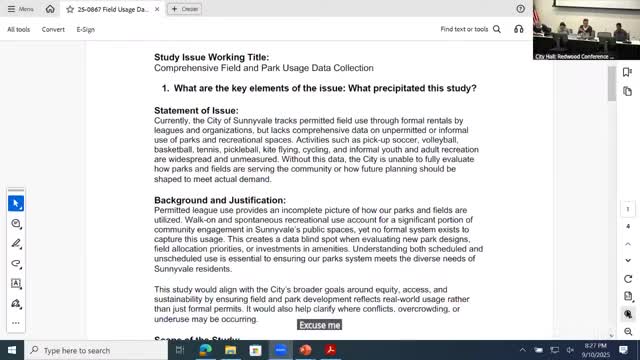
Summary
The Parks and Recreation Commission voted 4‑0 (one excused) Sept. 10 to add a comprehensive field and park usage data collection study to its work plan. Staff said a full pilot would require significant coordination and that a consultant estimated costs "probably north of $200,000."
The Parks and Recreation Commission voted to add a study that will explore methods to quantify informal, unpermitted use of Sunnyvale parks and athletic fields.
The study — titled “Comprehensive field and park usage data collection” — aims to capture walk‑on and spontaneous recreation (pickup soccer, informal basketball and other unscheduled uses) that the city’s rental records do not measure. The proposed scope includes pilot observational counts or sensor pilots, comparative analysis of reservation data versus observed use, identification of underserved activities and recommendations for ongoing data collection integrated into capital planning.
Commission action and vote
A motion to adopt the study issue passed at the Sept. 10 meeting, recorded as passing 4‑0 with one excused absence. Commissioners recorded as voting in the roll call were Vice Chair Mason (approve), Commissioner Vermont (approve), Chair Kesting (approve) and Commissioner Gauthani (recorded as “I approve” during roll call). The mover and seconder for the motion were not specified in the public record provided at the meeting.
Staff response and budget concerns
Staff cautioned that producing truly comprehensive usage data would require substantial coordination across Sunnyvale’s roughly two dozen park sites and across seasons. City staff said they had spoken with a consultant who, after preliminary scoping, estimated a consultant‑led program would likely run “probably north of $200,000 consulting fee,” and that pilot data collection and analysis would need staff time and possibly sensor or survey tools.
Commission and public comments
Commissioners and public commenters supported the study’s goals; one commissioner asked that swimming and aquatics usage also be captured. Members of the public and commissioners emphasized that walk‑on use and informal play can outsize formal reservations, and that capital and scheduling decisions (for instance, whether to add permanent pickleball courts) are made with incomplete data absent a study.
Next steps and constraints
With the commission’s adoption, the study will be added to the commission’s work plan for scoping. Staff flagged implementation constraints: staffing bandwidth to run a pilot, the need to capture seasonal differences, and the potential expense of consultant services or monitoring technology. Staff recommended scoping work to define a pilot that could be scaled to available resources and to report back with a budget estimate and approach for Council consideration.
Ending
The commission approved the study and asked staff to return with a proposed scope and cost estimate. The vote sends the study forward for work‑plan scheduling and future budgeting decisions by council.