
Council approves future land-use change along US 380 to permit light industrial, with close vote
Get AI-powered insights, summaries, and transcripts
Subscribe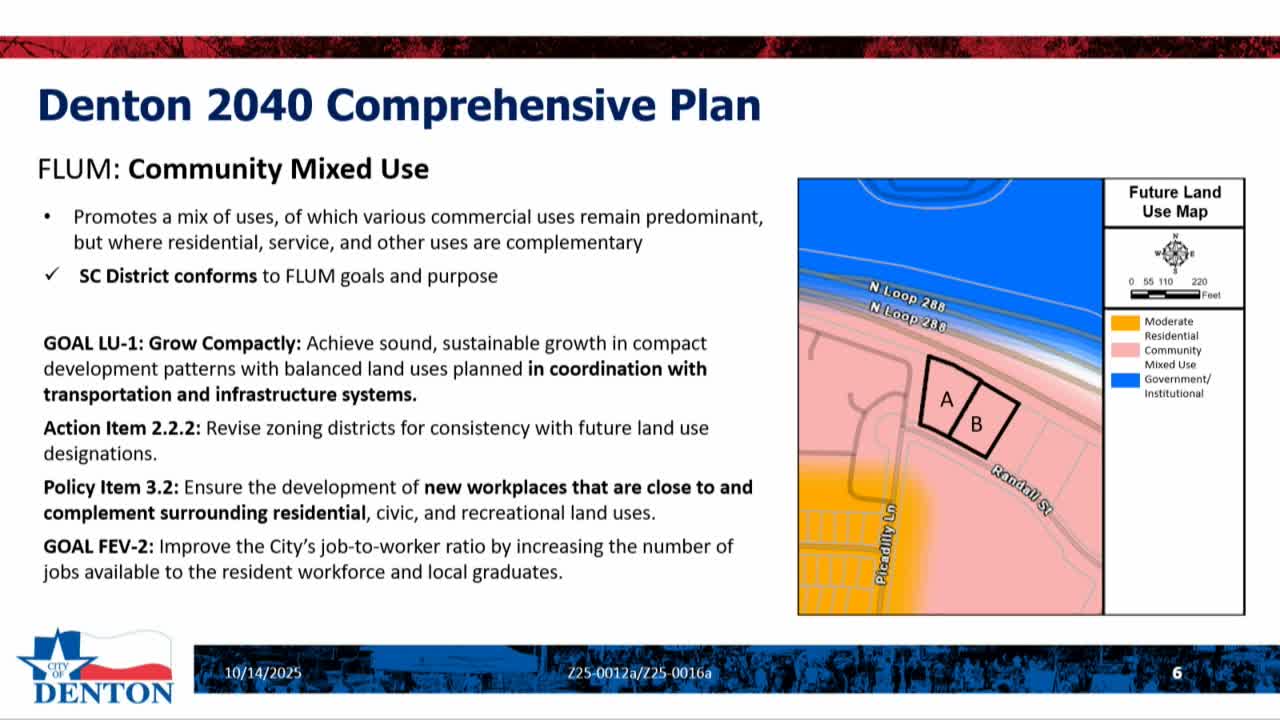
Summary
By a 4–3 vote the council amended the comprehensive plan to re-designate about 33.5 acres along US 380 from rural to light-industrial use (and 21.8 acres to community mixed-use elsewhere), following staff outreach and TxDOT corridor planning; some councilmembers said rezoning should wait until frontage-road designs are completed.
The Denton City Council on Oct. 14 approved a city-initiated amendment to the comprehensive plan re-designating approximately 33.5 acres east of North Trinity Road along US 380 from “rural area” to “light industrial” and moving about 21.8 acres from “low residential” to “community mixed use.” The vote on the primary light-industrial amendment was 4–3.
Staff presented the amendment as a response to multiple development inquiries and as an effort to align the city’s future land-use map with the existing development pattern and anticipated TxDOT improvements on US 380, including long-term plans for a freeway conversion and service/frontage roads. Staff noted that without municipal designation, similar uses are already developing in the extraterritorial jurisdiction (ETJ) and that adjusting the future land-use map would allow the city to require design standards and coordinate traffic/access on arterial corridors.
The light-industrial designation is intended to allow light manufacturing and warehousing with supporting office and retail uses; the community mixed-use designation on the adjacent parcels would permit predominantly commercial development with neighborly scale and buffering where residential lots currently exist. Staff said they conducted local outreach (two in-person and two virtual meetings) and mailed notices; attendance was limited and the presentations drew general support in those meetings. One e-comment to Planning & Zoning raised traffic concerns.
Council debate focused on safety and timing. Mayor Pro Tem and one other councilmember raised concerns about approving future frontage development before TxDOT completes frontage-road and interchange projects (projected between 2035–2040), warning that adding direct frontage uses before roadway capacity and signalization are in place could increase turning conflicts on a high-speed corridor. Transportation staff said future developments would be required to provide traffic analyses and access controls and that TxDOT controls the timing of major corridor improvements.
Council voted 4–3 to approve the plan amendments; supporters said the change brings development under city standards and helps the city manage growth near a major state corridor, while opponents said it risks encouraging development before roadway improvements are in place and preferred delaying or limiting rezonings until TxDOT’s frontage-road work is further defined.
No rezoning was approved as part of the comprehensive-plan action; subsequent zoning requests would return to council for review.