
Milton board reviews Riverwalk master plan, Broad Street and Willing Street redevelopment options
Get AI-powered insights, summaries, and transcripts
Subscribe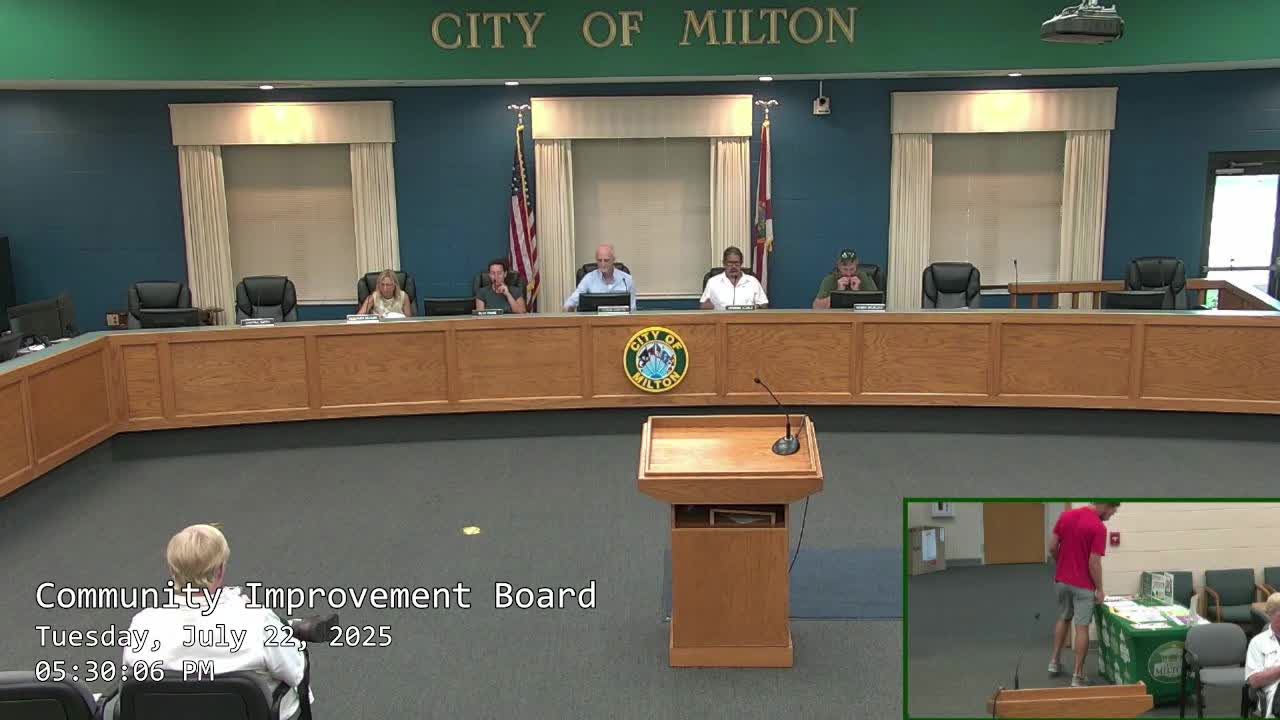
Summary
The Community Improvement Board convened in July to continue reviewing the Riverwalk master plan and related redevelopment ideas for Broad Street and the Willing Street (Blackwater Quarter) corridor, and directed staff to update plan materials and pursue grant funding.
The Community Improvement Board convened in July to continue reviewing the Riverwalk master plan and related redevelopment ideas for Broad Street and the Willing Street (Blackwater Quarter) corridor, and directed staff to update plan materials and pursue grant funding.
The board’s discussion centered on redevelopment concepts first: a marina with expanded wet slips, a banquet/meeting hall and restaurant at the Riverwalk south extension; mixed‑use residential and greenbelt preservation along Broad Street; and activation options for the Willing Street/Blackwater Quarter including improved sidewalks, angled parking and potential temporary street closures for events. Steven, a city staff member, summarized the draft outreach letter for property owners and described the master plan recap packet that members reviewed. “This draft was completed and reviewed this afternoon by the city manager, so this hasn't gone out just yet. This is still sitting under review,” he said.
Why it matters: board members framed the Riverwalk and downtown improvements as a way to preserve riparian vegetation, improve pedestrian and bicycle connectivity, and encourage new businesses — including hotels and river‑oriented retail — to locate downtown. Several speakers described the Riverwalk and Blackwater River as Milton’s primary assets and said the plan should emphasize walkability, public space and connections to existing trails.
Key planning elements and ideas discussed
- Marina and Riverwalk: Members renewed interest in expanding wet slips at the south end of the Riverwalk, adding dry storage and fuel/water service for recreational users, and preserving trees and buffers along the river. The board noted the city’s existing state submerged‑land lease covers the current dock footprint; any extension would need to be addressed in future RFPs or lease amendments.
- Boutique hotel and meeting space: The packet identified two parcels near Willing Street as possible hotel sites. Staff noted site constraints: a portion of the river‑side parcel lies in the floodway and local code currently limits building height to three stories. Board members discussed alternative sites (including a 5.8‑acre parcel cited in the packet) and tradeoffs such as parking, accessibility and fire department apparatus needs.
- Public infrastructure and access: Members discussed a pedestrian/ped-bicycle bridge across the Blackwater River or alongside Highway 90 to improve safe crossings and link downtown to Monroe Street and existing trails. Sidewalk infill was discussed as a lower‑cost way to increase connectivity; staff said two short infill segments could create three new linkages from Broad Street to the trail system.
- Downtown activation and public amenities: The board discussed options to activate underused riverfront space — food truck courts, outdoor seating, and seasonal closures for events — plus public restroom solutions. Staff and members cited off‑the‑shelf restroom options (including modular units and the Portland Loo model) but warned installation and site work raise total costs. One staff presentation estimated a high‑end modular restroom installation at roughly $250,000 including site work.
Funding and near‑term steps
Staff said the city will pursue a Department of Commerce CPTA planning grant (a planning grant of $75,000 identified in the packet) to support a refreshed master plan. Steven said the $75,000 planning grant could fund updated design work and that the city had been in contact with design firms about applying. The board also discussed a current Community Development Block Grant (CDBG) application for $2,200,000 that targets sidewalk and connectivity work; staff said the specific sidewalk connections raised in the meeting are not in the current CDBG scope but could be added to later applications and to the city sidewalk priority list if CDBG funding is not awarded.
Operational and implementation concerns
- Fire department apparatus: Board members noted that local code and fire response capabilities affect building height and hotel feasibility. A staff comment estimated that acquiring and operating a ladder truck could cost on the order of $1 million and would carry ongoing personnel and storage costs, a constraint to taller buildings.
- Property constraints: Staff reviewed parcel sizes and floodway lines in the packet; for one proposed hotel parcel staff estimated roughly 1.38 acres of developable land using property appraiser data and cautioned the appraiser data may differ from formal surveys.
Board direction and next steps
Staff will update the master plan packet and return at a subsequent meeting with revised materials and recommended priorities for sidewalk connections, parking strategies and potential bridge concepts. Staff also said it will proceed with the CPTA planning grant application and continue outreach to firms that might assist with the master plan. The CDBG application remains active and will determine near‑term sidewalk funding; if CDBG funds are not awarded, staff said the city will prioritize sidewalks through CRA review and other funding opportunities.
Votes at a glance
- Motion to approve the July meeting agenda with two additions — made and seconded; voice vote recorded as “aye” and the motion passed (voice vote; counts not specified).
- Motion to approve the May 27 minutes with corrections — made and seconded; voice vote recorded as “aye” and the motion passed (voice vote; counts not specified).
Community comments and council input
Speakers from downtown businesses and council offered input: Deb (restaurant owner) cautioned that a permanent closure of Willing Street could harm businesses that rely on drive‑up customers; Marilyn Ferro, a city council member, thanked the board for the brainstorming and urged use of incentives and parking strategies to attract investment. Several speakers suggested short‑term pilot actions (temporary street closures for events, food truck courtyards) while the long‑range capital projects are pursued.
Ending
Staff closed the item saying they will incorporate the meeting’s comments into the next packet, continue outreach on grant applications and return to the board with more detailed concepts and budget estimates at future meetings.