
Kyrene board retreat focuses on long-range facilities plan as district faces $6.7 million enrollment-driven shortfall
Get AI-powered insights, summaries, and transcripts
Subscribe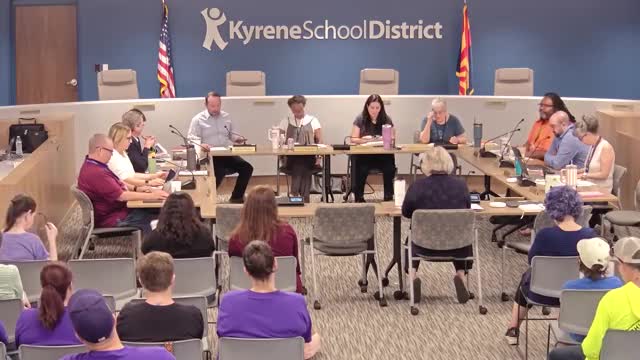
Summary
Trustees at a Sept. 9 Kyrene Elementary District board retreat reviewed a citizen committee’s long-range facilities recommendation tied to steady enrollment declines and a projected $6.7 million loss in state operating revenue over five years.
The Kyrene Elementary District governing board spent more than four hours at a Sept. 9 retreat reviewing a long-range facilities recommendation from a citizen committee and the district demographer that would reduce the district’s operating footprint as enrollment continues to fall.
The committee presented a facilities plan centered on closing or repurposing eight school buildings (six elementary sites and two middle schools) and repurposing a ninth building for a district gifted program; staff and the district demographer said that, if implemented as recommended, the move would largely close a projected $6.7 million decline in maintenance-and-operations (M&O) state funding that the district expects to accumulate over five years (the committee rounded that figure to $7 million for presentation).
Why it matters: district leaders said the drop in school-age population and a long-term decline in the district’s service rate — driven by lower birth rates, demographic aging and increased use of private/charter options and ESA vouchers — have reduced both enrollment and state M&O funding. Staff said the choice is between restructuring facilities now or relying on deeper program and staffing cuts later.
At the retreat, Director of Communications Erin Helm summarized the district’s community outreach and listening work, saying, “We are reading every single one of the public comments that comes through.” Helm told trustees the district’s long-range plan materials and a newly launched web hub are the focal points for ongoing hearings and feedback, and that website traffic surged after schools were named: 2,300 visits to the long-range planning page over the prior year and 5,500 visits in the five days after the August meeting.
Finance and enrollment: Finance staff explained the revenue math behind the recommendation. The demographer’s middle-of-the-road projection, staff said, estimates a cumulative decline of about 1,089 students over five years; converting those projected enrollment changes to average daily membership (ADM) under Arizona’s funding formula yields the roughly $6.7 million M&O shortfall across five years. “If you add that up over the next five years, it’s about 1,089 students,” a district finance presenter said.
District leaders emphasized the recurring nature of the loss: the projected annual decreases stack and compound, so balancing this problem requires ongoing reductions of comparable magnitude or structural changes such as consolidating facilities. Staff told the board the district has reduced roughly $24 million from its operating budget since 2017–18 through attrition, staffing adjustments and other efficiency measures, and has used one-time funds carefully to avoid depleting reserves.
What the committee recommended: The long-range planning committee’s working recommendation brought forward to the board identified six elementary and two middle school buildings for closure or repurposing (eight buildings total) and recommended repurposing one building for a proposed gifted academy; staff presented averaged cost and savings estimates the committee used: - Average recurring annual personnel savings per elementary building: about $500,000. - Average recurring annual day-to-day (M&O) operational savings per elementary building: about $300,000. - Average recurring annual savings per middle school building (personnel + day-to-day): about $1.3 million. Staff presented those averages to show how different closure combinations map to the $6.7 million target.
Capital vs. operations: staff and legal counsel warned that capital dollars (bonds, district additional assistance and other capital sources) cannot legally be used to plug M&O operating shortfalls. The district owns capital plans for the eight buildings identified by the committee that total about $53.9 million in planned capital work over a 10-year horizon; estimated demolition costs for all eight buildings, if the board chose demolition, were presented at about $6.2 million. Staff stressed those capital numbers are separate from the M&O savings needed to stabilize operating revenue.
Programs under discussion: Board members pressed staff about program impacts. The committee and staff highlighted two program areas that are tied to open-enrollment patterns and public interest: dual-language immersion and gifted services. Staff recommended testing a “repurpose” option that would create a district-level gifted academy (to consolidate self-contained gifted services), and also proposed keeping a robust dual-language program on both sides of I‑10 if the board wished to preserve districtwide access. Gifted program lead Beth Snyder summarized capacity and access issues: the district currently has about 1,000 students identified as gifted K–8, of which roughly 523 were elementary-level gifted identifications in the most recent year and about 163 students were enrolled in self-contained gifted classrooms. Snyder and staff said self-contained classes are difficult to sustain as enrollment drops because staffing and classroom-size targets create pressure to guest students or leave classes underfilled.
Dual language: staff presented data showing different open-enrollment patterns at the district’s two primary dual-language sites. One site (Norte) draws a much higher share of out-of-district students (staff cited roughly 59% out-of-district, about 298 students) while the other site (Lagos) has a majority of students living inside the district (staff cited roughly 19% out-of-district, about 82 students). Staff told trustees they could preserve a full dual-language school on one side of the freeway while maintaining a pathway (dual-language strand) on the other side; board members asked the demographer to rerun boundary adjustments so the board could bring that modified map to the public hearings.
Board direction, next steps and timeline: the board did not take a formal vote at the retreat. Trustees directed staff to present a revised version of the demographer’s map — modified to preserve dual-language access as discussed at the retreat — and to proceed with the planned public engagement schedule. The board has seven public hearings and staff told trustees the board would be asked to act on a final map at the December meeting; staff also said implementation of closures/consolidations had been planned as a phased rollout over three years but could be accelerated to two years for some scenarios if the board asked staff to examine that alternative and facilities/operations logistics allowed it.
What district leaders stressed: staff repeatedly told the board that closing fewer schools would reduce near‑term community disruption but would require larger program and personnel reductions elsewhere to make up the remaining operating gap. “You don’t get to the $6.7 million without reducing personnel,” a finance presenter said; the district also warned that timing and decisions about whether to retain or lease closed buildings strongly affect the amount and timing of savings because operational costs continue as long as the district owns and operates a building.
No formal vote: the governing board did not adopt a final plan at the retreat; trustees signaled that staff should return a modified map for the public hearings that preserves dual-language capacity as discussed. Staff said they will present the demographer’s revised map to trustees before posting materials for the hearings so the board can preview the adjusted boundaries.
Documenting the discussion: the district recorded staff estimates and background slides that will be included in the public materials. Trustees and staff said they expect follow-up questions from parents and staff about program placement, transportation, staffing impacts and the timeline for any final actions.
Quotes from the retreat
“We are reading every single one of the public comments that comes through,” Erin Helm, director of communications, told trustees as she outlined increased website traffic and outreach steps.
“If you add that up over the next five years, it’s about 1,089 students,” a finance presenter said when explaining how the demographer’s five-year enrollment projection converts to average daily membership and funding losses.
“This is not our first bite or last bite at the apple,” the board president said, emphasizing that the public hearings will be part of an extended process.
What the public should expect: staff said the district will publish a revised map and supporting materials ahead of the seven scheduled public hearings, and that the board will consider formal action on a final plan at a future meeting (planned for December). Staff also warned that some implementation steps (for example, personnel changes and reassignments) will take time and that certain savings — particularly capital savings or proceeds from property changes — are governed by statute and cannot be used to offset operating shortfalls.
The retreat closed with trustees agreeing to ask the demographer for a revised map that preserves dual-language access as discussed and to take the revised proposal into the public hearings.
Ending: The governing board adjourned the retreat without taking formal action and set follow-up presentations, community hearings and additional staff planning steps ahead of the December decision window.