
Elkhart committee reviews draft zoning rules for battery energy storage amid safety and grid concerns
Get AI-powered insights, summaries, and transcripts
Subscribe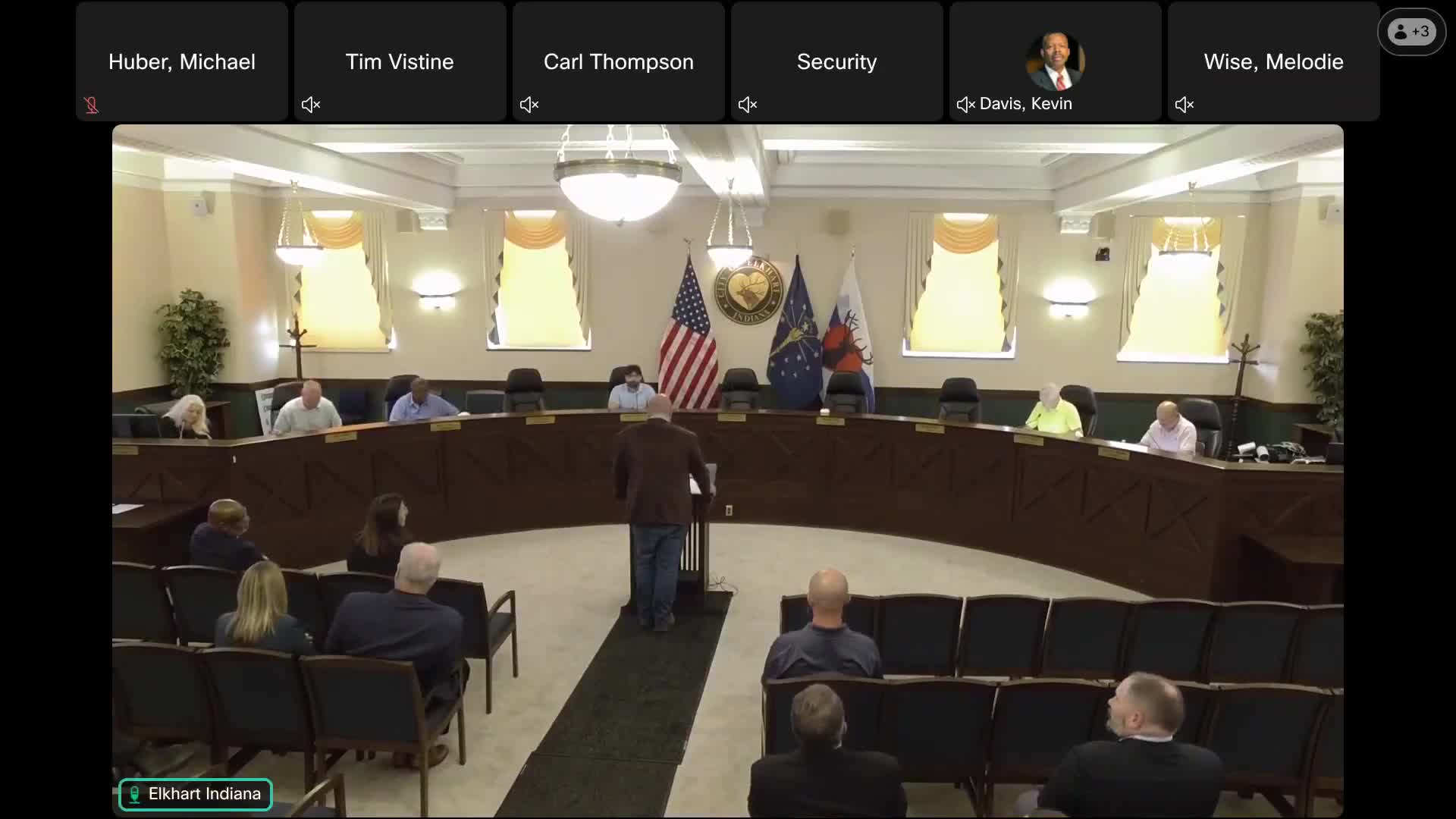
Summary
City staff and outside experts explained how battery energy storage works, potential community benefits and risks, and draft Unified Development Ordinance (UDO) conditions including setbacks, decommissioning bonds and fire-safety requirements.
Staff and outside experts briefed the Elkhart City Public Health and Safety Committee on battery energy storage systems and draft Unified Development Ordinance language for siting and operating those facilities.
The presentation, given at a committee work session, explained how batteries can provide supplemental grid capacity for regional data-center growth, described industry safety and testing standards, and outlined draft local zoning rules that would treat battery energy storage systems as a special-exception use in the manufacturing district.
The issue matters because county and regional demand for electricity is growing and Elkhart-area leaders said the aging grid and new data-center customers are driving interest in storage. Chris Steger of the Economic Development Corporation of Elkhart County told the committee that “about 70% of our grid is over 25 years old,” and warned that projected demand could increase strain on local service. He said a recent outage on the city’s southeast side cost a group of businesses hundreds of thousands of dollars in lost revenue.
Battery experts described technology, uses and safety protocols. Becca Gillespie of the Battery Innovation Center summarized the basic function: batteries store energy for later use, provide peaking capacity and help frequency regulation. She emphasized two core technical measures for projects — power (megawatts) and energy (megawatt-hours) — and gave the common example of a “10 megawatt, 4 hour” system equal to 40 megawatt-hours.
Lehi Alexander, CEO of the Battery Innovation Center, said lithium-ion chemistries dominate today’s grid-scale projects and that lithium iron phosphate (LFP) is widely used for grid installations because of cost and safety characteristics. Industry speakers noted several large Indiana projects, including multi‑hundred‑megawatt installations that went online in 2025.
Eric Wood, a senior consultant with Energy Safety Response Group and a former firefighter, described destructive testing and the role of codes and standards in reducing risk. He said U.S. testing labs run cell, module, rack and full-enclosure tests and cited the National Fire Protection Association standard NFPA 855 and UL testing protocols (UL 9540 / UL 9540A) as central references. Wood said that testing now makes outward thermal propagation harder to trigger than it was in earlier years and that integrated battery-management systems provide multiple layers of protection.
City planners outlined proposed UDO language to regulate future projects. Eric Trotter, with the planning department, and Cynthia Bowen, the city’s consultant, said the draft would treat battery energy storage as a special-exception use in the manufacturing district and impose site standards including:
- Conformance with applicable local, state and national codes and standards (NFPA 855 and applicable UL standards). - Maximum facility height: 30 feet above ground. - Setbacks: 500 feet from the nearest nonparticipating parcel and 200 feet from the nearest edge of public right of way (draft language). - Landscape buffer up to 30 feet, potential berming, and underground utility lines with downcast lighting. - Exterior security fencing (no barbed wire in the draft), numbered/locked access gates with Knox-boxes. - A complete noise analysis and compliance with the city noise ordinance. - Emergency fire-safety plan coordinated with Elkhart County emergency management and the Elkhart Fire Department. - Decommissioning plan and a performance bond or equivalent at 125% of estimated decommissioning cost, updated every five years, with removal required within 12 months after cessation of operations. - Annual operations and maintenance reporting and minimum insurance (suggested $2 million per occurrence / $5 million aggregate) naming the city as additional insured.
Committee members asked about land use, timelines, safety and public impacts. Councilman Kirk asked how much land a project would use; presenters said installations are modular and can be compact—for example, a 200‑megawatt, 4‑hour plant can occupy about five to six acres, though setbacks and buffer requirements would increase total site footprint. On timing, developers face variable interconnection‑queue delays; presenters said a project could be built in roughly two years in an ideal interconnection environment but that queue delays often extend timelines to five to seven years.
On safety and emergency response, presenters and a consultant from Energy Safety Response Group described multiple protective systems (cell‑level, rack‑level and site controls), monitoring and emergency-response planning. Eric Wood said water is the least‑worst suppressing medium in tests, but that applying water can prolong a thermal event; his team advised defensive firefighting and said their testing showed off‑gases similar in composition to residential structural fires (hydrogen, hydrocarbons, carbon monoxide and carbon dioxide) and did not recommend routine public evacuation for tested event profiles. Panelists also noted the move toward containerized systems and LFP chemistry as safety improvements.
Speakers noted economic and system benefits: presenters said energy storage can supply firm capacity at lower dollar-per‑kilowatt cost than some alternatives, reduce peak pricing in capacity markets, provide distribution and transmission support, and deliver limited long‑term tax and construction employment benefits. Cynthia Bowen said business‑personal‑property valuation and tax treatment (including depreciation rules) should be reviewed case‑by‑case if projects are proposed.
No formal applications or votes were before the committee at the session; city staff said the meeting was informational and that no project has yet come forward for permit review. Planning staff and the city consultant said they will refine draft UDO language in response to questions raised at the session and bring formal ordinance language back to the council when appropriate.
The committee closed with staff promising to consider the technical, fiscal and emergency-response questions raised before any final local rules are adopted.