
Public defense urges staggered phase‑in of caseload standards, requests staffing and space to meet new workload
Get AI-powered insights, summaries, and transcripts
Subscribe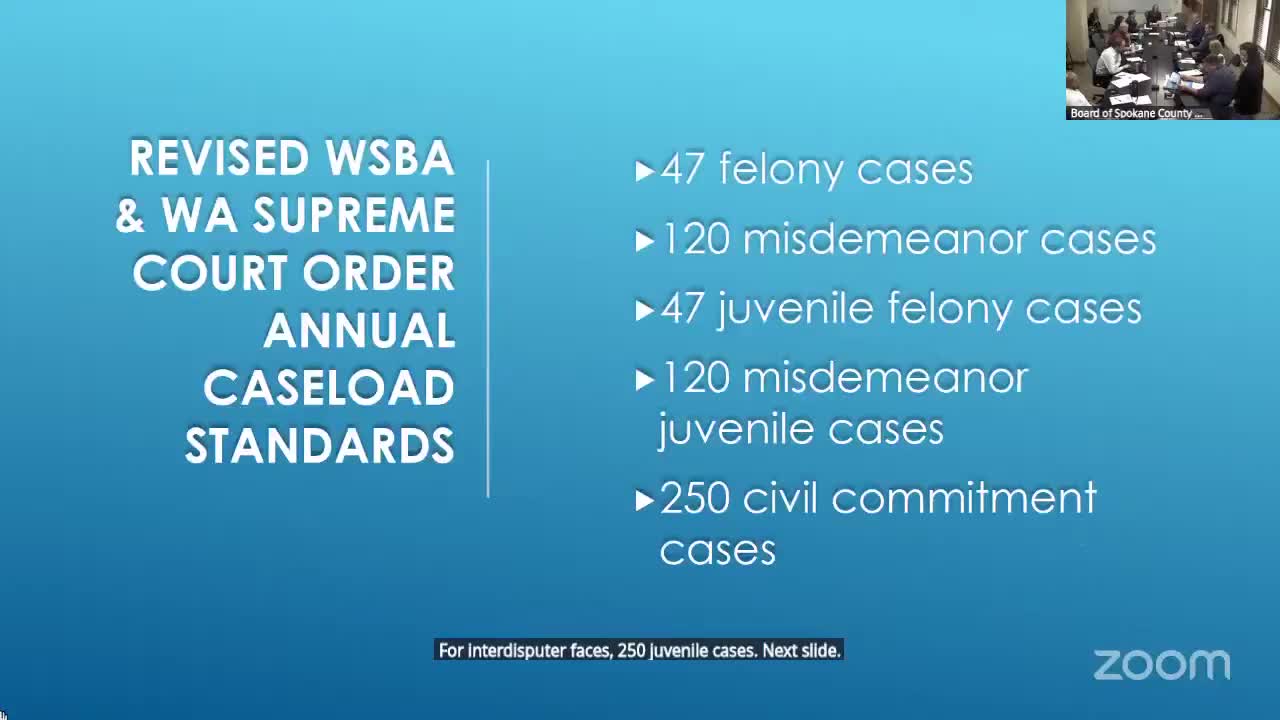
Summary
Counsel for Defense told commissioners new Washington caseload standards and Supreme Court guidance require additional juvenile attorneys, investigators and space; the office proposed a 10% annual phase‑in to full implementation and requested county and state funding coordination.
Counsel for Defense (CFD) presented its assessment of caseload changes required by revised workload standards and a Washington Supreme Court order, and outlined staffing and space requests to meet the new requirements.
CFD said the earlier federal and state case‑weighting studies and a recent Supreme Court order will change the per‑attorney case credits the office must track. The office described past and proposed caseload caps: prior internal standards had assumed roughly 100 felonies and 400 misdemeanors per attorney; the new Supreme Court target would be 47 felony case credits and 120 misdemeanor credits per full‑time appointed attorney for any 12‑month period once fully implemented.
CFD recommended a phased approach to implementation because immediate compliance over three years would be “financially impossible” and would exacerbate existing attorney shortages. The office proposed a 10 percent annual reduction in per‑attorney workloads as a practical pathway to reach final implementation over roughly a decade, noting the Supreme Court allowed delayed implementation. Counsel for Defense requested targeted hires for juvenile defense—five additional attorney I/II positions based on caseload calculators in juvenile court—an additional criminal investigator, another paralegal and a legal secretary. The office also asked the board to consider space to accommodate growth and confidential attorney‑client meeting rooms.
CFD emphasized the cost of transferring cases to private counsel when the office is overloaded: outsourcing serious felony defense can cost more in attorney payments and expert witnesses than handling cases in‑house. The presentation included an example homicide file with hundreds of hours of video and phone data to illustrate the time needed per serious case under the new standards.
CFD noted the office historically participates in the state RCW 10‑101 (referred to in the presentation as 10 1 0 1) funding application process and suggested one of the juvenile attorney positions might be funded through those state funds if the county and state coordinate funding decisions.
Commissioners asked several operational questions, including how “direct reach” is defined and whether the proposed phase‑in could meet bar association ethics and workload guidance; CFD replied that mandatory time tracking and local case‑credit adjustments would be part of a phased approach and that attorneys could still individually decline additional cases under ethical rules. No formal budget decision was made.
Ending: CFD asked the board to consider a long‑term staffing plan, space and support to implement revised caseload standards with a phased timeline; budget staff and CFD will continue coordination on funding sources, including potential use of state RCW funds.