
Council begins budget-priorities discussion; members propose reviewing repeat-offender fines as public commenters press for more police and fire resources
Get AI-powered insights, summaries, and transcripts
Subscribe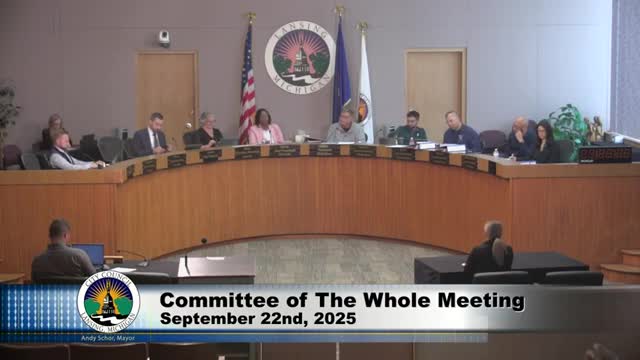
Summary
On Sept. 22 the Committee of the Whole opened debate on fiscal-year 2026–27 budget priorities, including a council-initiated request to study increasing fines for repeat ordinance violations. Public commenters urged higher priority for Lansing Police and Fire staffing and raised housing maintenance concerns; city legal staff reminded the committee
The Lansing City Committee of the Whole opened discussion Sept. 22 on budget priorities for fiscal year 2026–27 and instructed administration to study potential changes to fines for repeat ordinance violations.
Council member Spadafore said he was initiating a budget-priority item to prompt administration to examine whether a graduated or higher fine structure could better deter repeat violations such as trash, grass and certain parking and property-use offenses. “The fine structure could be altered to discourage repeat of offenses,” Spadafore said, and he moved to add a study of repeat-offender fines to the priorities for the coming budget cycle.
City Attorney Greg told the committee the Home Rule City Act limits municipal financial penalties to $500 per event, which constrains how high a penalty the city can set for a single violation. Legal staff and council members discussed the practical differences among enforcement authorities: police write citations for on-street violations, Parking Services issues parking citations, and Code Compliance enforces property- and premise-related violations such as front-yard parking or unregistered vehicles. Council members said they would like clearer operational guidance and said staff may return with a flowchart or clearer assignment of enforcement roles.
The committee’s budget-priorities discussion followed public comments that urged the council to fund public safety and highlighted housing-maintenance problems. One resident urged the council to prioritize Lansing Police Department (LPD) and Lansing Fire Department (LFD) staffing and equipment over other proposed budget items, saying he heard “at least three times … over the weekend on the scanner where there were no officers available citywide to respond to a call and at least twice that there were no medics available.” The resident described a recent river-trail shooting where first responders had limited access and a victim was reached “about 20 minutes after the call came in.”
Public commenter Demaria Beard raised housing maintenance and tenant-safety concerns at specific properties, telling the committee fire alarms were being pulled “every single day” at a building she identified as 3200 South Washington and noting problems with bedbugs, rodents and electrical issues in some housing. Beard said she had contacted the Lansing Housing Commission and state legislators and asked councilmembers to treat the budget discussion as linked to on-the-ground housing and 311 complaints.
Council members clarified that a prior fee study addressed recovery of city costs for certain fees but did not change the structure of fines; Spadafore and others said the council’s intention with a budget-priorities directive is to start the conversation and direct staff to return with options. Council member Hussain noted precedent for increasing small community awards to $1,000 in other contexts while other members requested staff analysis of which violations can be treated as daily offenses and how repeat-violation penalties have been implemented in premise-code and parking contexts.
No final budget priorities were adopted at the Sept. 22 Committee of the Whole meeting; councilmembers said committees are still finalizing their recommendations and that a subsequent meeting will present a drafted resolution incorporating any agreed changes.