
Public works details sidewalk repair surge, AI pavement ratings and preventive maintenance plan
Get AI-powered insights, summaries, and transcripts
Subscribe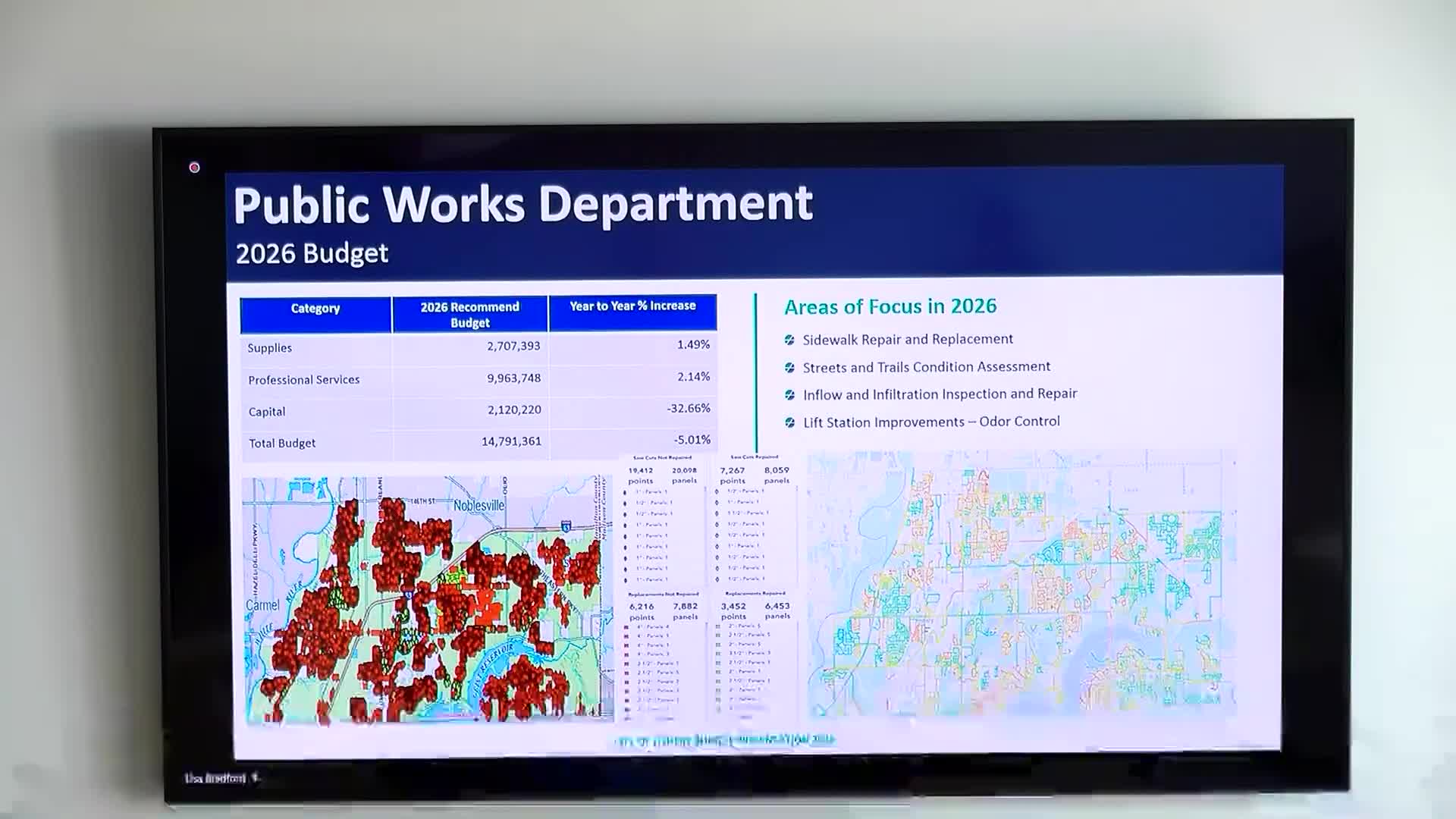
Summary
Public works described a renewed emphasis on sidewalks (saw cuts and panel replacements), use of AI pavement-condition ratings, trail and parking-lot assessments, CCTV sewer inspections, odor-control chemicals and lift‑station upgrades as part of a preventive-maintenance strategy.
Public Works staff told the finance committee the department is prioritizing sidewalks, preventive maintenance and data-driven asset management to improve safety and reduce emergency repairs.
“By ordinance, it is technically the homeowners responsibility to maintain, those sidewalks,” the public-works presenter said while describing an active program to repair saw cuts and panel replacements and a dedicated concrete crew.
Key points: - Sidewalk program: staff reported roughly 8,000 saw cuts and 6,000 panel replacements on record, and said last year the group completed about 1,100 saw-cut repairs; recent weekly production topped 100 saw cuts in one week. Staff noted the city is proactively repairing sidewalks for safety despite homeowner maintenance ordinances. - Pavement and condition assessment: the city is using an AI tool (Biolytics) to capture pavement images and produce PASER-style condition ratings to guide resurfacing and preventive maintenance priorities. - Sanitary system: the department runs inflow and infiltration inspections with CCTV to find and repair problem pipes (emergency repairs are several times more expensive than preventive work); staff said proactive repairs reduce treatment-plant flows and delay capacity expansion. - Odor control: a chemical (calcium nitrate) program implemented upstream of problematic lift stations has substantially reduced odor complaints (from about 15–20 per week historically to near zero in treated areas, staff said). - Lift stations: the city operates 53 lift stations and continues pump, valve and panel upgrades with asset-management planning.
Committee members asked about ADA and crosswalk improvements in specific neighborhoods; staff said some crosswalks require intersection work to meet ADA standards and are queued with the engineering department. A request for a temporary railing at a storm‑drain hazard produced an answer that staff had solicited quotes and hoped to have installation before the end of the construction season if budget allowed.
Ending: staff said the data-driven condition-assessment work will inform next year’s resurfacing packages and help align public-works work with engineering projects to maximize value.