
Senate committee advances SB4 after hours of testimony on Texas congressional map
Get AI-powered insights, summaries, and transcripts
Subscribe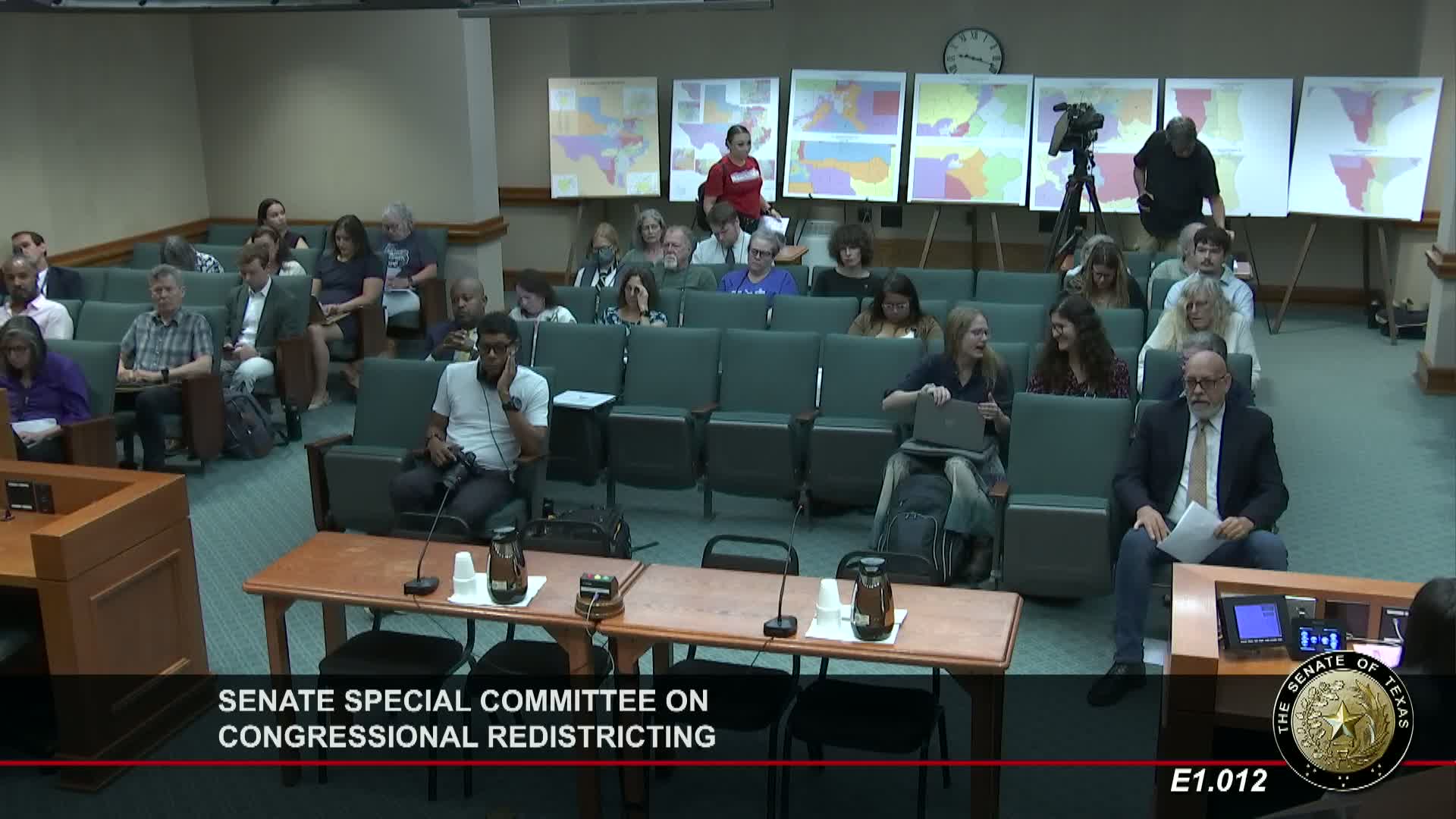
Summary
Senators in the Texas Senate Special Committee on congressional redistricting voted to report Senate Bill 4 to the full Senate after a day of public testimony and debate over whether the companion map filed in the Senate is a lawful redraw or a partisan effort to reduce the political power of Black and Latino communities.
Senators in the Texas Senate Special Committee on congressional redistricting voted to report Senate Bill 4 to the full Senate after a day of public testimony and debate over whether the companion map filed in the Senate is a lawful redraw or a partisan effort to reduce the political power of Black and Latino communities.
The chairman and author, Senator King, told the committee SB4 is based on 2020 census figures and “meets the 1 person, 1 vote standard,” arguing the plan redraws 37 of 38 congressional districts to be, in his view, more compact and to “elect more Republicans to the U.S. Congress.” He said he had legislative counsel review the map before filing it as a senate companion to the house plan.
Opponents — including civil-rights advocates, local elected officials and a long line of public witnesses — urged the committee not to advance the bill. Witnesses said the proposed lines would “pack and crack” communities of color, break existing communities of interest, and likely be the subject of additional litigation. Gary Bledsoe of the Texas NAACP told the committee the proposed map “is a blatant attempt to rob Texans of color of their political power.”
Why it matters: redrawing congressional lines determines which voters are grouped together for U.S. House elections and can change which party is likely to win seats. The committee’s action moves the Senate-authorized map closer to a Senate floor vote while opponents say the change would be implemented well before any final court review could be resolved.
What the plan does: Senator King summarized high-level features of SB4, saying the proposal redraws 37 of 38 congressional districts and makes the most significant changes in five districts — CD 9 (Houston), CD 28 (Rio Grande Valley), CD 32 (Dallas area), CD 34 (South Texas/coastal), and CD 35 (San Antonio area). King said the map’s “ideal district size” is 766,987 people and that the proposed plan complies with federal law as he understands it.
Public testimony and concerns: dozens of Texans testified in the hearing room and by remote registration. Many witnesses pressed legal and practical objections: several civil-rights lawyers and voting-rights advocates argued the map would dilute minority voting strength in districts the courts and prior litigation have identified as “ability to elect” or opportunity districts. Veronica Warms of the Texas Civil Rights Project said SB4 “makes an already discriminatory map that is still being litigated even worse.” Witnesses from Austin, Corpus Christi, the Rio Grande Valley and Houston described how their communities would be split among geographically distant districts, which they said would hinder constituent services and emergency response coordination.
Author and supporters: Senator King repeatedly said he did not use racial data in drawing the plan and that the map was chosen because it met legal review and because he believes it improves compactness and partisan performance. Supporters at the hearing and in written materials emphasized compactness and the long-established legal standard of equal population for congressional districts.
Opposition and legal risk: opponents pointed to a recent letter from the U.S. Department of Justice and to existing litigation over 2021 maps. Civil-rights witnesses and several senators warned that the map appears to target majority-minority districts and could prompt swift federal court challenges. Gary Bledsoe and other witnesses said prior litigation and court findings identify several districts with statutory protections that should not be dismantled. Several speakers noted the large public response to the process: Senator King referenced 205 witnesses at regional hearings and 3,668 written comments submitted to the public portal.
Committee action: Senator Sparks moved that SB4 be reported favorably to the full Senate with the recommendation that it do pass. The clerk recorded the committee tally reported at the close of the hearing as six ayes, one nay, one present not voting and one absent; Senator Hinojosa also submitted a written no vote as part of the record. The committee chair indicated his intent to recommend the bill for favorable reporting to the Senate.
Next steps: the committee recommended SB4 to the Senate. If the full Senate advances the bill, the House would still need to act for a final congressional-redistricting change to become law; opponents noted litigation could delay or overturn the map even if the Legislature approves it. Several committee members and witnesses urged the body to consider alternative priorities raised during the special session, including flood recovery and disaster relief, as multiple witnesses said those were urgent needs for Texans.
Meeting context: the hearing occurred during the governor’s special session on redistricting, a 30-day convening the governor called after the 2020 census and related litigation. Senators and witnesses repeatedly referenced earlier regional hearings and an invited-witness session, and many public participants said they had testified in prior hearings and via the public portal.
What committee members said: Chairman Senator King said the map “is more compact” and “complies with all applicable law” as he presented it. Senator Miles called the process and the map a “racist” power grab and said he would not vote to advance the bill; other senators asked technical questions about communities of interest, compactness, and how testimony should inform potential amendments.
The public record: the committee accepted written comments through the public portal and limited oral testimony to two minutes per person because of the number of registrants. The committee chair said staff had processed thousands of portal submissions and were redacting personal information before making the documents public.
Ending note: with the committee’s favorable recommendation, SB4 moves to the Senate floor for further consideration. Senate members and outside groups signaled immediate plans for litigation or floor amendments; voting-rights groups and several members of the congressional delegations already recorded opposition during earlier house hearings and in submitted testimony.