
Senate committee hears hours of testimony on SB 7, Texas Women’s Privacy Act; committee adopts substitute and reports bill favorably
Get AI-powered insights, summaries, and transcripts
Subscribe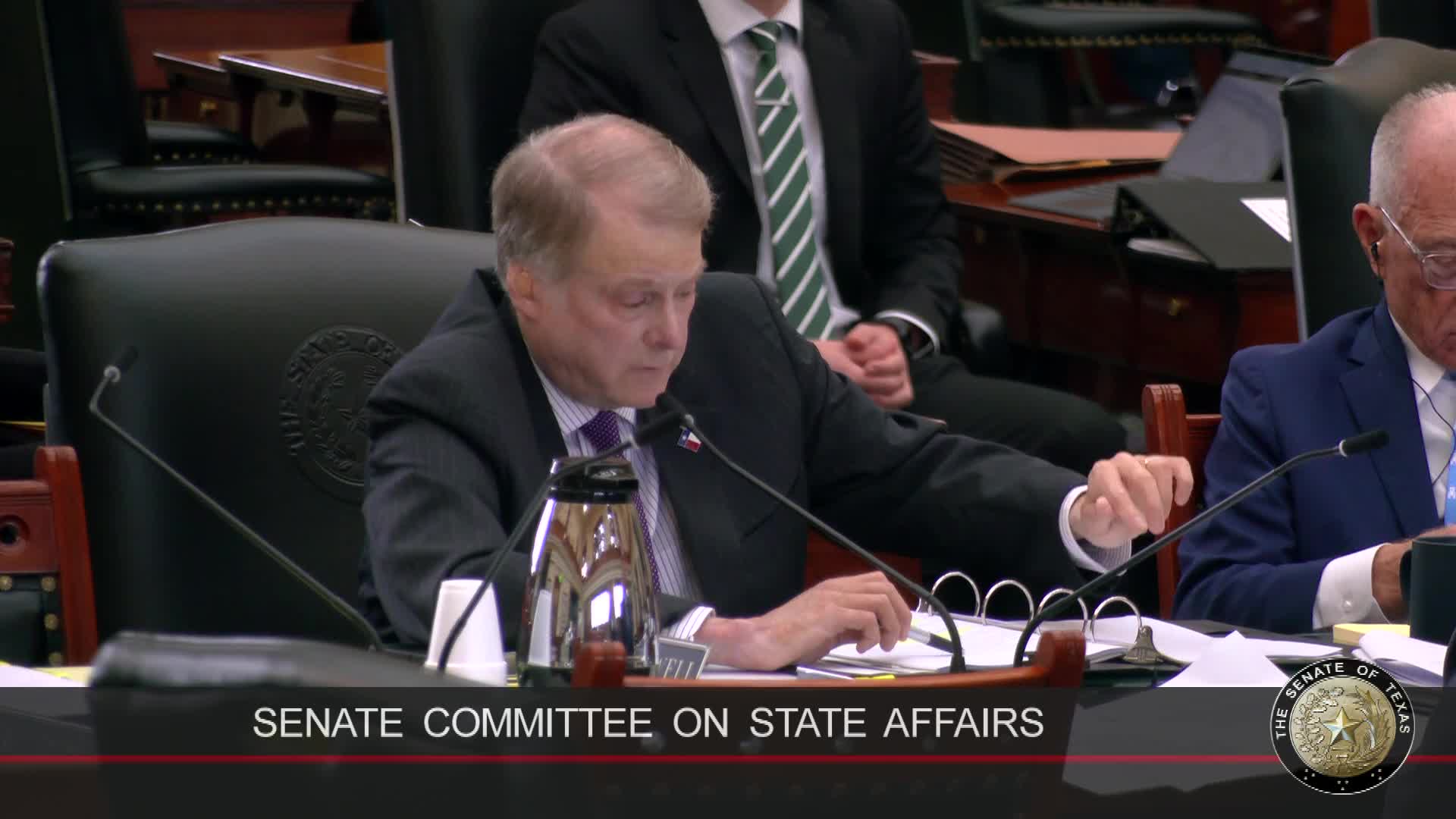
Summary
The Senate State Affairs Committee heard extensive invited and public testimony on Senate Bill 7, the Texas Women’s Privacy Act, including personal accounts and legal arguments. The committee adopted a committee substitute and voted to report the bill favorably to the full Senate.
The Senate State Affairs Committee held a lengthy hearing on Senate Bill 7, the Texas Women’s Privacy Act, hearing invited witnesses and more than one hundred public commentators before adopting a committee substitute and voting to report the bill favorably to the full Senate.
Senator Bryan Middleton laid out SB 7 as legislation that would require public facilities owned by state agencies and political subdivisions to designate single‑sex private spaces according to biological sex, he said, and to confine corrections housing and similar spaces by an individual’s biological sex. The author told the panel the bill preserves single‑use and family restrooms and includes exceptions for emergencies, children, disabilities and law enforcement. Under the bill, he said, civil penalties of $5,000 for a first violation and $25,000 for subsequent violations would be enforceable by citizen complaint and by the attorney general; Texans would also have a private right of action. The author said the bill designates the Fifteenth Court of Appeals as the exclusive intermediate appellate court for related litigation and does not remove the ability to appeal to the Texas Supreme Court.
Supporters included mothers and survivors who described incidents they said illustrated why separate women’s spaces are needed. Kim Slusser told the committee about her daughter’s experience on a college women’s volleyball team and urged lawmakers to protect women’s privacy in locker rooms, hotels and shelters. Amy Ichikawa, who said she had been incarcerated, told the panel she’d seen men moved into women’s facilities in California and urged passage to protect incarcerated women. Faith‑based leaders and conservative groups testified in favor, repeating the bill’s safety and privacy rationales.
Opponents — including transgender Texans, civil‑rights groups, health professionals and advocacy organizations — argued the bill would harm transgender people, increase stigma and create practical enforcement problems. Testimony included legal and constitutional concerns (references to potential conflicts with the Prison Rape Elimination Act and other federal obligations), mental‑health impacts on youth, and the practical difficulty of identifying “biological sex” in public spaces without intrusive verification. Witnesses including the ACLU of Texas, the Transgender Education Network of Texas and individual physicians said available evidence does not show transgender people are a public‑safety threat in single‑sex facilities and warned that shelters, schools and prisons could face unintended consequences.
Family‑violence advocates told the committee they support protecting survivors but raised practical questions about shelters and urged the committee to clarify that family members and dependents can remain housed together. Jennifer Mudge of the Texas Council on Family Violence asked that family‑violence centers and residential shelters not be disadvantaged by the bill’s language and requested explicit protections so victims could continue to stay with dependents.
After more than three hours of testimony and public comment, the committee adopted the committee substitute offered by the author and then voted to report SB 7 favorably to the full Senate. The chair announced the roll call and reported the motion carried with seven ayes and no nays. The committee record shows the substitute will be refined further before floor action.
What’s in the bill and what lawmakers flagged as unresolved: SB 7 as presented would: - Require public facilities owned by state agencies or political subdivisions to designate single‑sex private spaces by biological sex, while preserving single‑use and family restrooms and allowing limited exceptions. - Require corrections housing to follow biological sex for housing assignments. - Create civil penalties ($5,000 first violation; $25,000 subsequent violations), enforceable through citizen complaints and by the attorney general, and permit a private right of action. - Designate the Fifteenth Court of Appeals as the primary intermediate appellate court for challenges (with appeals to the Supreme Court still permitted).
During questions lawmakers pressed the author on practical matters: how counties and family‑violence shelters would operate when families include adolescents of both sexes; whether state agencies’ review or enforcement would require centralized filings in Travis County or local venue; and the interplay between the bill and prior or companion legislation defining sex for official records. Senator Birdwell and others asked for clearer language to ensure local courts and local agencies retain the ability to try cases where events occurred locally; the author agreed to work on an amendment to clarify venue and related procedural protections.
Discussion vs. decision: The committee’s action was procedural — adoption of a committee substitute and a favorable report to the Senate — not a final law. Many witnesses produced personal narrative and policy arguments; several committee members said they would work with the author on amendments before floor consideration. The committee’s vote sends SB 7 to the full Senate for additional debate and possible amendment.
Why it matters: SB 7 would change how public‑sector entities and corrections agencies determine access to bathrooms, locker rooms, shelters and similar facilities across Texas. Supporters say it restores privacy protections for women and girls; opponents say it will exclude and harm transgender Texans, complicate shelter operations, and create legal and constitutional challenges. Lawmakers asked staff to refine venue and implementation language and to clarify the bill’s interaction with shelter rules, federal obligations (including PREA), and the state appellate structure.
Next steps: The bill was reported favorably to the full Senate. The author and members signaled they will work on clarifying amendments before the measure is scheduled for floor consideration.
Sources: Committee hearing on SB 7, invited testimony and more than 100 public witnesses (testimony included named speakers cited below); committee substitute adoption and roll‑call recorded in the hearing.