
Plumbing TAG debates sizing rule for cycling sump pumps; no formal action without quorum
Get AI-powered insights, summaries, and transcripts
Subscribe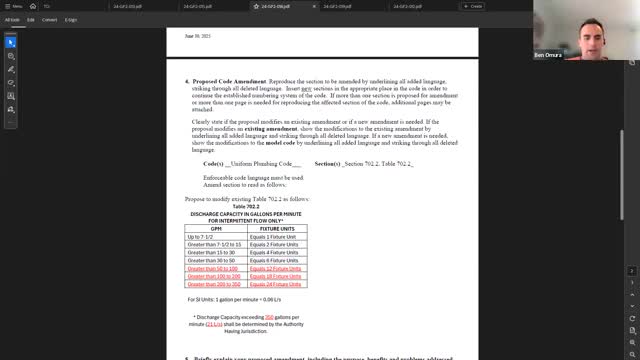
Summary
The Plumbing Technical Advisory Group discussed a proposed code change (GP2019) to treat cycling sump pumps as intermittent fixtures for fixture-unit (DFU) calculations, raised sanitary-ejector concerns, and asked the proponent to revise language clarifying scope; the TAG could not vote because it lacked quorum.
The State Building Code Council Plumbing Technical Advisory Group met virtually to review GP2019, a proposed change to how sump pumps and similar cycling pumps are classified for plumbing sizing. Steven (TAG member) explained the proposal’s basis: “The hundred and 80 seconds is basically, based on the 10 starts per hour,” and that manufacturer guidance for cycling pumps typically assumes about three minutes on and three minutes off.
The proposal would let intermittent-flow tables apply to some sump pumps instead of treating them as continuous flows at 2 DFU per gallon-per-minute, which can force oversized downstream loads. Steven told the group that a pump pair sized at 125 GPM each (potentially 250 GPM running together for a sprinkler event) might normally be designed for high instantaneous flow while the system’s average everyday flow could be 5–10 GPM. Under current rules, “you’re looking at eating up…500 DFUs of capacity,” he said, describing how worst-case design can create a “phantom load” in building piping.
Several TAG members raised safety and public-health concerns. Steve Simpson (TAG member) said the code term “ejector” commonly implies sanitary solids and warned about undersizing sanitary drains: “When you say the word ejector in the plumbing code, you’re talking about solid waste. Right?” He urged caution if the change could apply to systems carrying toilets or other sanitary waste. Dave (TAG member) likewise questioned the proposal’s handling of cycle timing and inflow rate, noting the draft text could allow short downtimes that still result in frequent starts; he said he preferred retaining a 2 DFU-per-GPM approach for sanitary ejectors unless the scope clearly limits the change to clear-water applications.
Because of those concerns, Steven offered to prepare revised language that would limit the proposed intermittent classification to clear-water drainage and reconsider how the downtime assumption is framed; TAG members suggested looking at an exception in the Seattle plumbing code as a model. Staff confirmed revised proposals may be resubmitted to the SBCC mailbox (bgroat@des.wa.gov) and entered as revised proposals.
No motion or vote was taken during this meeting because the group did not achieve quorum. The discussion concluded with a direction for the proponent to return with edited language clarifying scope and cycle assumptions for further review and public comment.
The TAG distinguished discussion from action: the group debated technical and safety tradeoffs, asked for a revised proposal, and received process guidance from staff; there was no formal adoption or change to the code in this meeting.