
Trustees press Austin ISD to spell out special-education transitions and staffing in consolidation plan
Get AI-powered insights, summaries, and transcripts
Subscribe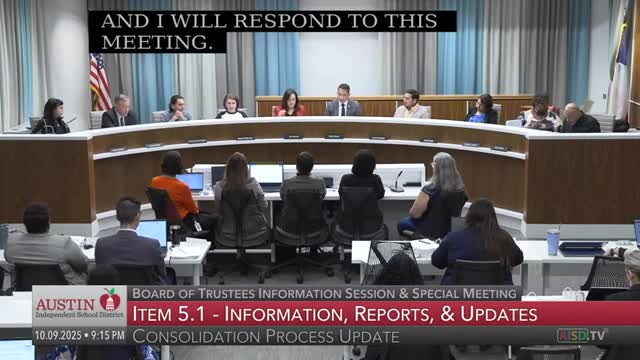
Summary
Board members said the district must provide a detailed plan for special-education placements, IEP meetings and staffing ratios before consolidations proceed; trustees described the community’s need for clear timelines and assurances that services will continue.
Trustees at the Austin ISD board meeting repeatedly raised special education as a distinct, high-priority concern in the district’s consolidation and transition planning, asking administrators for clear staffing plans, timelines for IEP meetings and assurances that services will continue without interruption.
Trustee D’Aurelios (speaker identified in the meeting) told the board the special-education community needs more than the broad-strokes language in the draft proposal: “The amount that we've talked about dual‑language education…almost everything that was said about that should be talked about for special education as well,” the trustee said, listing issues that require specific answers, including staffing ratios, placement options, and the volume of IEP meetings that the transition will require.
District leaders said the special-education department has been heavily engaged in the last several months because of a TEA ordered agreement and that staff recognize the scale of the work. Administrators said the draft plan currently states that students will still receive services in their IEPs and that, where attendance-bound changes force placement adjustments, ARD/IEP meetings will be held before the school year ends to confirm services or make alternate arrangements.
Trustees asked for a more explicit, campus-by-campus inventory of the continuum of services and for the district to model the operational implications of reassignments (for example, whether receiving campuses will need additional special-education teachers or related services personnel). Trustee Cullen asked the administration to show how special-education services will be preserved and, where necessary, improved rather than simply continued.
Administrators said they will provide additional detail prior to the November vote and emphasized that staffing and program placement decisions will be addressed in advance of transitions. Trustees asked that the district’s communications to families clearly describe what will remain unchanged, what individual families must expect (including whether reassignments will require ARD meetings), and the supports the district will provide for a compressed timeline of special-education transitions.
Trustees described special education transitions as district‑wide in scope because families with IEPs live across the city; members asked for a higher level of engagement targeted to special-education families, a timeline for IEP meetings tied to the consolidation schedule, and a commitment that service continuity will be a primary criterion in any campus reassignments.
Administrators agreed to follow up with a timeline and a campus-level plan for special-education services and to include these items in the materials they will publish ahead of the November information session.