
Planning commission reviews multiple proposed changes to Marine Mixed Use rules ahead of Oct. 22 hearing
Get AI-powered insights, summaries, and transcripts
Subscribe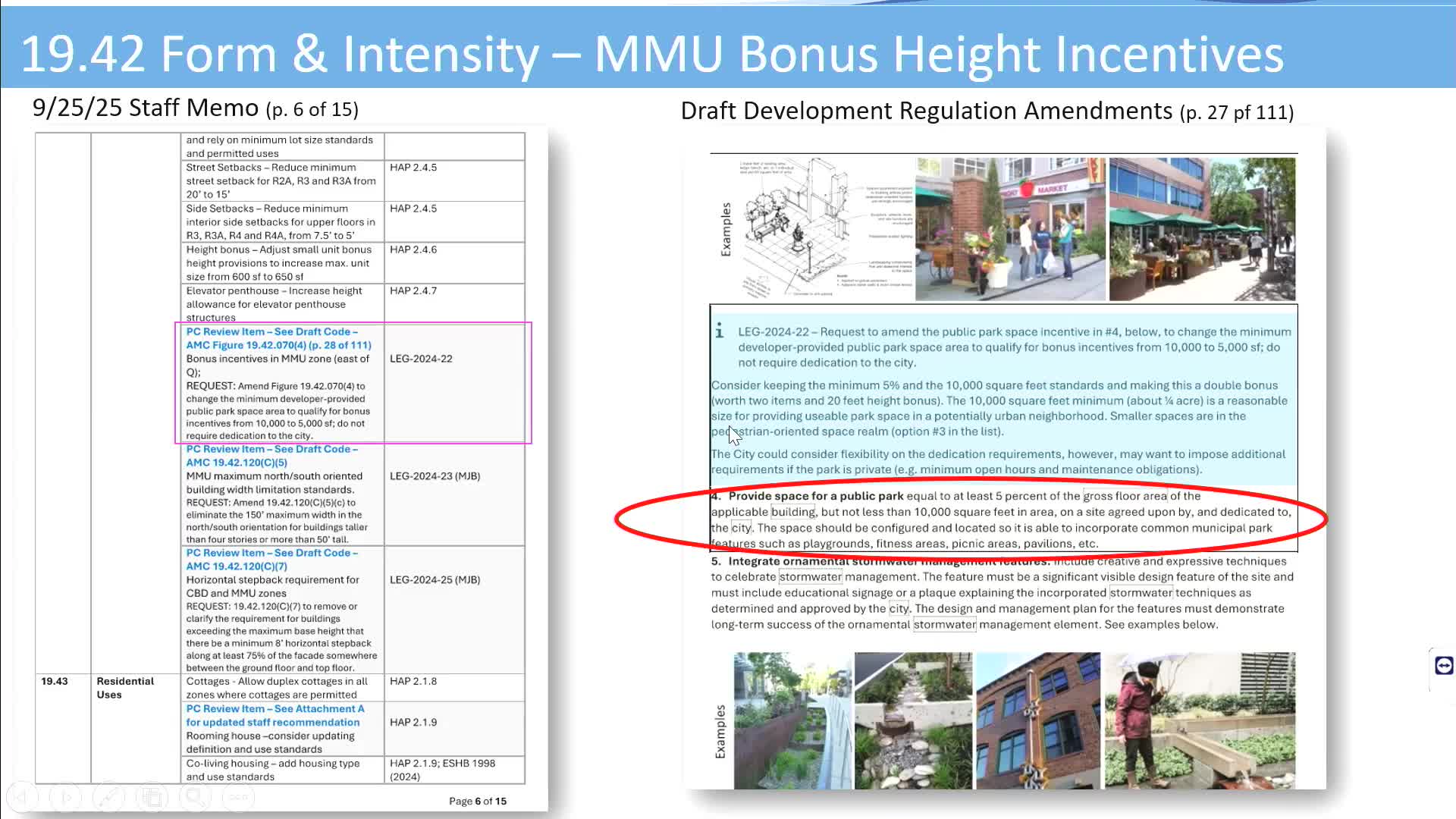
Summary
City planning staff and developer MJB Properties debated proposed changes to the Marine Mixed Use (MMU) portion of Anacortes' development regulations, including park-size bonuses tied to added building height, whether required open space should count toward a 60% residential cap, building width limits for taller structures, and other design rules.
Acting Chair opened the Planning Commission’s Oct. 1 special meeting to continued discussion of the 2025 development regulation amendments, focusing first on several requested changes to the Marine Mixed Use (MMU) zone that cover Anacortes’ central Fidalgo Bay waterfront. Planning Manager Libby Grage summarized staff recommendations and the public comment window, noting the written comment period remains open through Oct. 22 and a public hearing will be held that evening at 6 p.m.
The most contested requests came from MJB Properties, represented at the meeting by Jimmy Blaze. Blaze asked that the city lower the minimum area required for a public-park bonus from 10,000 square feet to 5,000 square feet (or otherwise make the 5%-of-gross-floor-area calculation work more equitably) and to allow a developer to provide and maintain the space without transferring title to the city. "The goal of this was just to make it equitable and align in the code here too," Blaze said, adding that requiring dedication to the city creates maintenance and ownership conflicts.
Staff recommended keeping the 5% threshold and the 10,000-square-foot minimum but suggested treating a qualifying public park as a higher-value bonus (a double bonus) if the developer provided the larger space; staff also recommended conditions if the city allowed private ownership with public access, e.g., maintenance and availability requirements. Grage warned that any flexibility on dedication would need further standards to ensure perpetual public access and upkeep.
Commissioners and the developer also discussed the MMU standard that limits the north–south width of buildings taller than 50 feet to 150 feet; MJB asked that the width limit be raised to 200 feet (the existing limit for shorter buildings). Grage reiterated that departures already exist: projects may propose alternatives demonstrating they meet the standard’s purpose (reduced perceived bulk and preserved marine views). Several commissioners split on the issue; one commissioner said the departure path removes the need for a separate conditional-use process, while others favored retaining the 150-foot limit as written to preserve public views.
A related discussion addressed how the city counts onsite landscaping and open space when enforcing the MMU rule that single-purpose residential buildings may cover up to 60% of a site. MJB asked that required landscaping and minimum open-space areas tied to residential buildings not be counted against the 60% cap; staff said required minimums should remain counted but suggested as a compromise that landscaping and open space provided above the minimum could be excluded from the 60% calculation. Commissioners signaled support for clarifying language so that required minimum landscaping is not double-counted while optional park space could be treated differently.
Commissioners asked several technical questions about the existing MMU rules: the base height is 45 feet with options to reach 65 feet through public-amenity bonuses; one listed amenity awards 10 feet of bonus height per qualifying feature; staff said the code requires a 10,000-square-foot minimum park for that particular amenity and that a public dedication was the original intent. Grage and Blaze discussed how required site-wide corridors, view studies and building massing standards already break up building walls and may limit perceived scale even if width limits are eased.
No formal votes were taken on MMU text at the Oct. 1 meeting; staff said the commission’s comments and any additional direction would be incorporated into a revised packet by the Oct. 22 public hearing. The written comment period remains open until 3 p.m. Oct. 22; the Planning Commission may deliberate and make a recommendation to City Council that evening.