
City unveils pilot "home hardening" program using $100,000 to help residents prepare for wildfire
Get AI-powered insights, summaries, and transcripts
Subscribe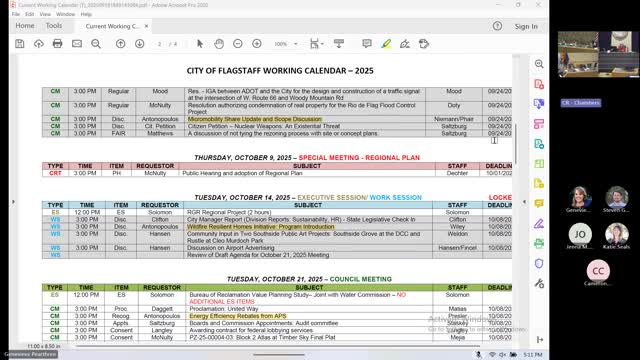
Summary
The Sustainability Office described a pilot wildfire‑resilient homes initiative that will offer free home assessments, kits, and a small grant fund, and will be introduced to City Council Oct. 14.
The Flagstaff Sustainability Office on Sept. 25 described a pilot wildfire‑resilient homes initiative funded with $100,000 that will provide free home assessments, homeowner kits and a small grant to pay contractors for people unable to do the work themselves. Jenna, a sustainability staff member, said the program aims to "help people harden their homes," a phrase the city uses for measures that reduce building vulnerability to wildfire.
The program matters because wildfire risk is a persistent local hazard and the pilot is intended to test scalable interventions for community resilience. Jenna said the funding provides for home assessments performed by sustainability or wildland fire staff, a kit with yard tools and mesh covers for vents and screens, and a small application grant to pay contractors when homeowners cannot perform the work. "We're also partnering with Steve and his team to hopefully launch some really cool neighborhood level volunteer events to get a bunch of volunteers to go and just help do the work," Jenna said. She added, "We won't be asking volunteers to be running chainsaws or anything like that."
Staff said they will present the program to City Council on Tuesday, Oct. 14, and will focus outreach on modeled high‑risk neighborhoods this year because limited funds and staff mean the pilot cannot reach all households. Outreach will include targeted neighborhood events, possible mailers and a press release; the program is open to all residents but early efforts will prioritize neighborhoods identified as higher risk by fire modeling tools.
Jenna said the pilot is intended to create a model that can be scaled with additional funding. The commission did not take a formal vote on the pilot on Sept. 25; staff committed to provide materials and a Council presentation on Oct. 14.